


A leadership pipeline you can show the board
Assess the people two levels down, see potential across the whole population, and read the bench whenever you need it rather than once a year.
TRUSTED BY TEAMS RUNNING MAJOR CHANGE
What makes a leadership pipeline worth trusting
Four things sitting behind the read on potential.
MOTIVE AND TALENT
Most questionnaires ask people what they believe they are good at. Our behavioral assessment measures that alongside what actually drives them, so you can separate durable capability from passing interest.
VALIDITY THAT HOLDS
Validity of 0.57 against an industry standard near 0.3, and 27 out of 30 in the independent British Psychological Society review. A weaker instrument puts the wrong names in front of the board.
THREE KINDS OF LEADER
Potential is not one score. Alongside a core leadership indicator, people are read for operational, people and strategic leadership, so you can tell who should run an operation from who should set direction.
BUILT TO HOLD UP
People present themselves well when a promotion is at stake. Our science is built to stop that. Alongside rating each statement, people rank statements against each other, so agreeing with everything is not an option and only what genuinely stands out scores.
The evidence behind every succession conversation
Every output connected to the succession decisions that carry the most risk.
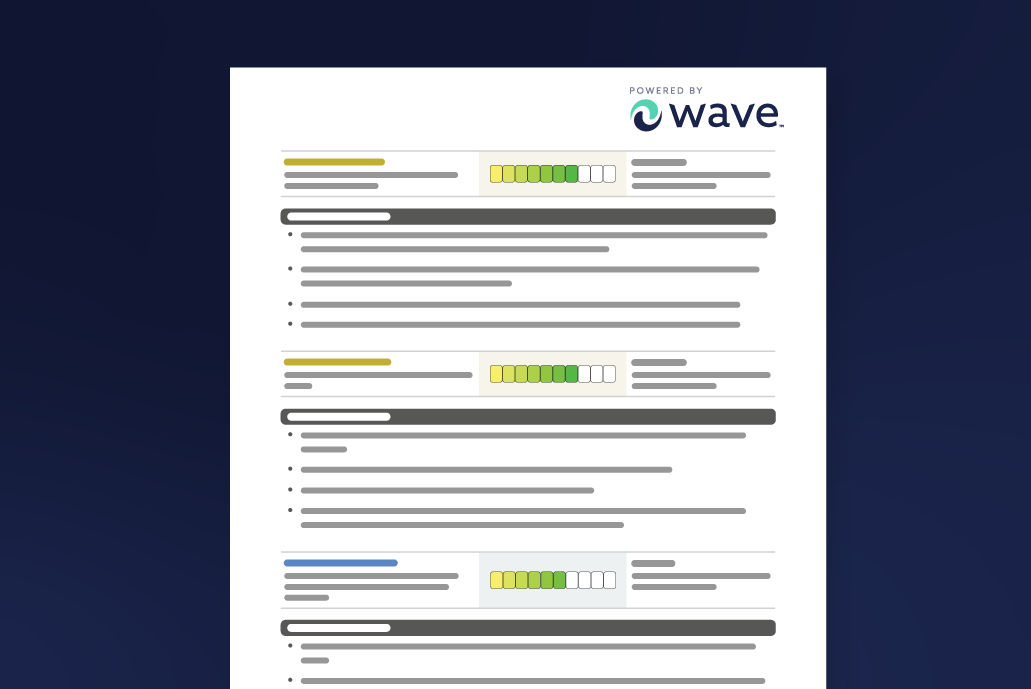
A theme by theme view of each person's strengths, gaps and potential risks, written so a line manager can use it in a conversation without a psychologist in the room.

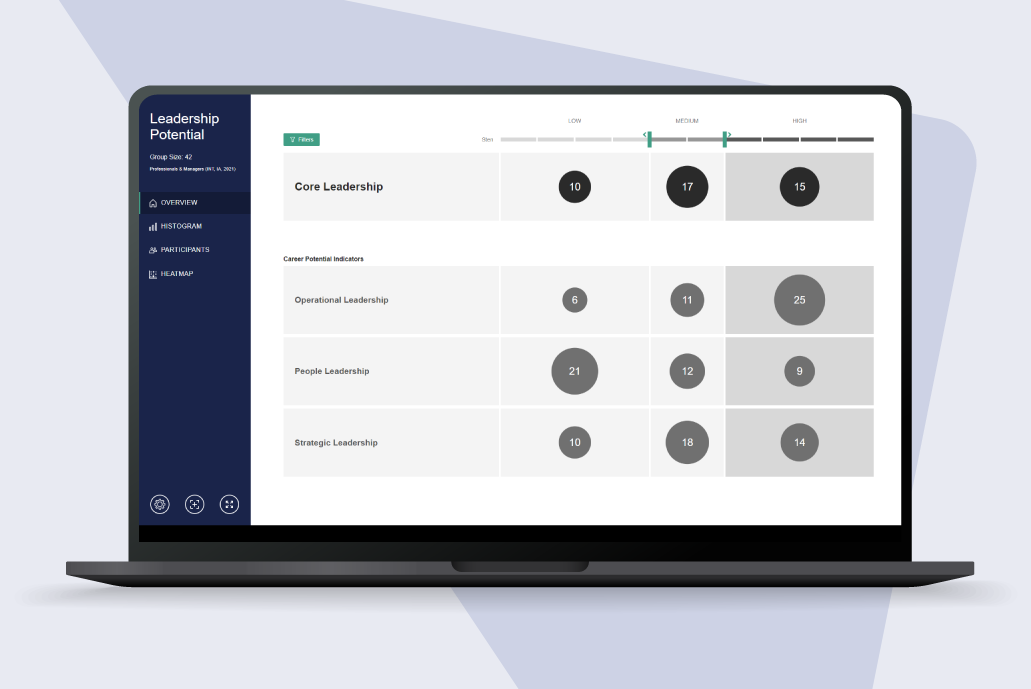
Potential across everyone assessed in the Leadership Potential Dashboard filtered by division, team or talent segment, so you can read a whole leadership team together and see where the bench is thin months before a role opens.
Practical guidance built on the specific behaviors behind each person's result, so somebody identified as a successor knows what to work on before the move rather than after it. Where a gap needs a program rather than a plan, that sits with leadership development.

Your leadership model, your scoring and your branding, so the reports and the dashboard read and look like the systems your people already work in rather than something bolted on the side.
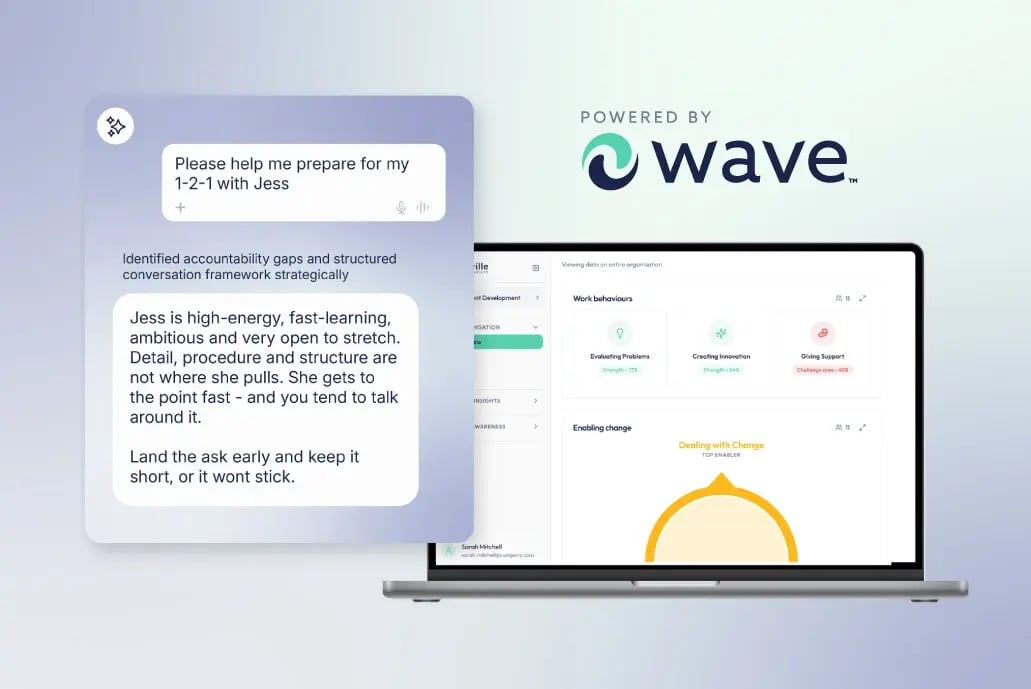
Ask about a person, a team, or a conversation you are about to have, inside the AI assistant your managers already work in. Clients running Wave Connect Develop get the same potential data answering questions in the flow of the working day.
Why it works
Whole population
Nomination shows you the people managers can see. Assessment reads everyone, and helps you identify the people who have been flying under the radar.
- No nomination round needed
- Divisional and team views
- People nobody nominated
Potential, not performance
Performance in today's role is a weak guide to the next one. Potential is read against what the bigger job will actually demand, the same evidence behind high-potential programs.
- Readiness, not reputation
- Derailer risk made visible
- One standard for everyone
On demand
Read the bench when a role opens or a restructure lands, rather than waiting for the annual cycle to come round again.
- No annual freeze
- Add people as they join
- Refresh without reassessing everyone
Is your leadership pipeline built on the right people?
Tell us how you choose people for your leadership pipeline, how many are in it and how many you considered. You will see how many may not have leadership potential, how that compares with Saville, and who you might be missing.
Two pipelines built on evidence
Skanska runs safety critical operations across a global business. Promotion and succession used to run on reputation and on whoever was in the room, which varied between business units and was hard to justify to a panel. Structured behavioral evidence replaced it, with leadership risk and derailer behaviors visible before the decision rather than after it.
“Saville helps us find people sooner and accelerate them.”
people under one promotion and succession standard

A succession bench that refreshes when you need it
An international health and beauty retailer of more than 14,000 people ran succession through an annual nine box cycle built on manager nominations. Reading potential on demand instead put 60 leaders through the first cohort, identified 5% more women as having leadership potential than the old process had, and took the bench off a once a year timetable.
more women identified with leadership potential

Frequently asked questions
The questions talent teams ask before they take a pipeline to the board.
A leadership pipeline is the group of people inside your organization who could take on your critical roles, with evidence behind each one. It covers who is ready now, who is ready with development, and where you have no internal answer at all.
Through a leadership potential assessment rather than a nomination. Each person completes one behavioral assessment, and the results are read against what leadership success looks like in your organization, so potential is measured on the same standard for everyone.
It gives the grid something objective to sit on. Most talent reviews start with manager ratings, which measure visibility as much as potential. Assessment data means the conversation starts from the same evidence for every person, including those in teams the senior team rarely sees.
As soon as a cohort has completed. Potential can be read on demand rather than on an annual cycle, so a new division, an acquisition or a restructure can be assessed when it happens instead of waiting for the next review round.
No. The outputs are written for talent teams and line managers to use directly. Where you want expert input, our consultants run the calibration session, or train your team to run it themselves.
No. Where you already run succession planning in an HR system, this supplies the part it is missing: an objective read on potential for every person, rather than a manager rating typed in after a talent review.
Talk to us about your succession bench
Tell us which roles worry you most. We will show you what the evidence looks like.