


Leadership development assessment that earns its budget
The leaders who most need to grow rarely know where. This tells them, and tells you what your leadership spend actually changed.
TRUSTED BY TEAMS BUILDING THEIR NEXT GENERATION
How leadership development assessment works
From a single assessment to visible change
THE READ
A leadership development assessment reads motives and talents together: what genuinely drives a leader, and what they do well. Where the two pull apart is the development priority.
THE OTHER VIEW
Leadership Impact 360 adds how five rater groups see them: boss, peers, reports, others and themselves, rated across the same nine areas. Ten minutes each, with written comments.
THE CONVERSATION
An expert debrief turns the reports into a plan the leader believes. Your HR team can be accredited to run these through our training program, or our consultants can.
THE FOLLOW THROUGH
Afterwards the insight stays available in the tools people already use, so it shapes the conversations that follow. Re-run the 360 twelve months on to see what changed.
What aiming it properly is worth
Most leadership programs are aimed by nomination. These are the modeled differences when the same budget is aimed by evidence instead.
4x
Development impact around four times that of the average tool in our benchmark
60%
More accurate read on where a leader actually needs to develop
75%
Of development effort that would otherwise fall flat, recovered
Everything a leadership program needs to land
Four parts, used together or separately, depending on how far along your program already is.
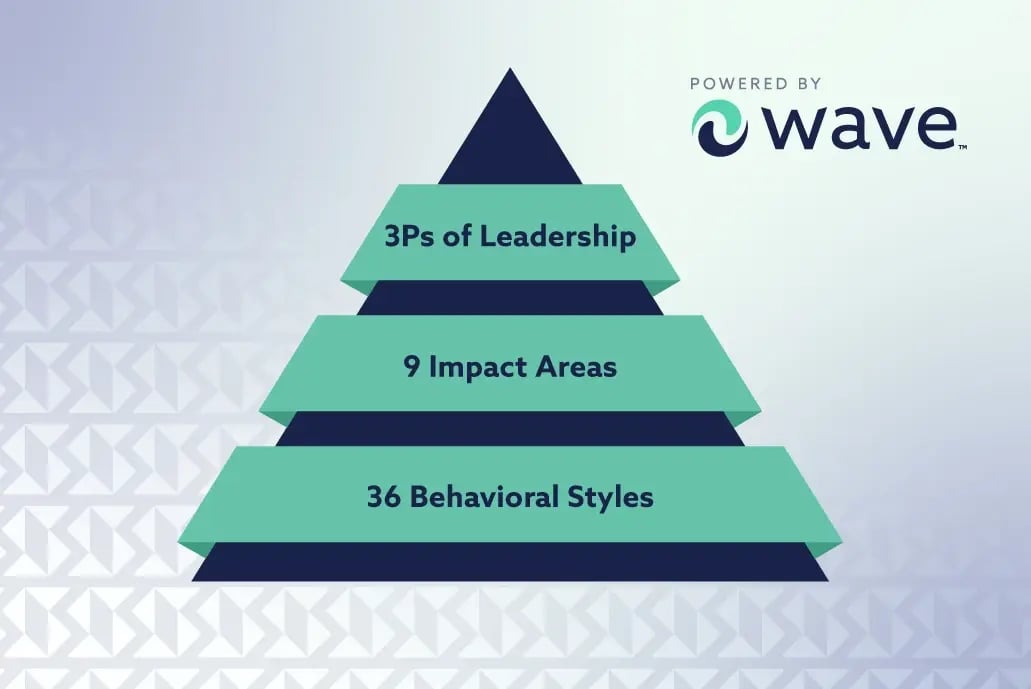
A deep read across the nine leadership impact areas, built on the behaviors most predictive of leadership impact at work. Leaders rarely know where to aim their own development effort. This tells them, and it is there to come back to when it matters most.
How boss, peers, reports and others actually experience them, rated against the same nine areas, with written comments alongside the scores. Ten minutes per rater. The gap between how a leader sees themselves and how the room sees them is usually where the development sits.

A one to one session that turns the reports into two or three commitments the leader believes, rather than a document they file. Your own HR team can be accredited to run them, so the conversation reaches further than your top thirty people.

The strengths that stop working under pressure, and the behaviors that quietly undermine a capable leader. Read before a promotion or a restructure, this is the part of the picture most leadership programs never surface at all.

Why it works
Aimed properly
Most leadership budgets are spread evenly across people whose development needs are nowhere near the same.
- Priorities per leader, not per cohort
- One group view across the whole team
- Spend aimed where it moves something
Measured properly
Re-run the 360 twelve months on and you have a before and after, not a feedback form and a hope.
- The same nine impact areas
- Self view against rater view
- Evidence for the board conversation
Used properly
The leader and whoever supports them both want to go further with the results, inside the AI tools you already use.
- Nothing new to log into
- Ask it in your own words
- Independently reviewed science underneath
What untargeted leadership development is costing you
Tell us how you decide what each leader needs to develop today, how many leaders are on the program and your industry. You will see what targeting development with Saville gives back each year in spend you stop wasting and productivity you gain.
Developing leaders through change
A global bank needed its senior leaders to lead a major change program rather than survive it. Leadership Impact and Leadership Risk reports, one to one debriefs, then a group session that put the leadership team's whole pattern on a single page.

Frequently asked questions
The things talent leaders ask before they start.
A leadership development assessment measures how a leader works, not how they performed last year. It reads their motives and their talents, shows where they are likely to have the most impact, and turns that into specific development priorities rather than a personality label.
Development grows the leaders already in post. Identifying who could step up next is pipeline and succession work, which uses the same assessment but a different output. Start with leadership pipeline for that.
Not always. The behavioral assessment on its own gives a leader their strengths, their risks and their priorities. The 360 adds how boss, peers and reports actually experience them, which is usually what shifts a leader who believes they already know.
Yes. HR teams and internal coaches can be accredited to interpret the reports and lead the development conversations themselves, with our consultants available for senior or complex cases.
Wave® scored 27 out of 30 in the independent British Psychological Society review, across six technical areas, and its predictive validity is 0.57 from an independent co-validation study of 308 people. An industry standard assessment sits nearer 0.3. The leadership impact reports run off that same instrument. The science behind Wave® sets out the method in full.
Re-run the 360 at the end. The same nine impact areas are rated again by the same rater groups, so movement is visible rather than asserted. Our ROI model sits alongside that to project the value of aiming development spend more accurately.
Talk to us about your leadership program
Tell us where your leaders are now and what the program has to prove.