





Rank 1,000+ people, not 1,000+ keyword matches
Volume recruitment, one person at a time. Measure every applicant against what good looks like in that specific role, however many apply, and regardless of who or what wrote their resume.
About 90%
of the predictive power of a 45 to 60 minute structured interview, in about 2 minutes
12 items
one for each area of behavioral effectiveness
115 ATS
connectors available, with no integration fee
THE ORGANIZATIONS THAT ASSESS WITH US
What volume recruitment costs you today
A thousand applications is a day of reading, and that assumes thirty seconds each. Thirty seconds is a glance.
Give each application the minute it deserves and you have lost the week. What you get for that time is the two things a resume reliably contains, years of education and years of experience, both near the bottom of what predicts performance.
Volume to longlist is one job.
Longlist to shortlist is another
Most volume hirers make both with the same weak instrument, or make the first and skip the second. The funnel has to narrow twice.
Stage one · Volume to longlist
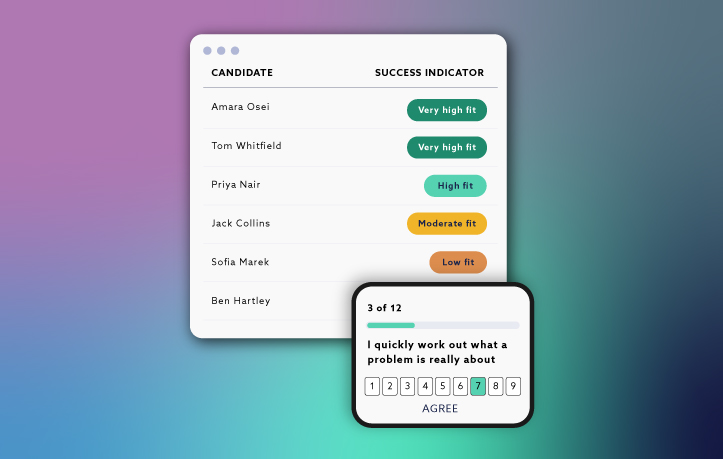
The Saville Screener has Twelve questions, takes about two minutes and is fired from your ATS to everyone who applies. It returns one result against every candidate so you can rank and prioritize, and no resume is read at any point.
- Built on the Wave® item bank, rated 27 out of 30 across six technical areas by the British Psychological Society
- Scoring equations built to reduce age, gender and ethnicity differences
- AI reads your job description to work out what good looks like. It never meets the candidate
Stage two · Longlist to shortlist
The Behavioral Snapshot assessment is for the people who make the longlist. This is the stage that turns a ranked list into a shortlist worth interviewing, and it is a different job from ranking a thousand people. It is also where the odds change: across our behavioral assessment range, the risk of a serious mis-hire moves from 1 in 5 to 1 in 50.
- A fuller read on how someone actually works, for the people worth the time
- Reports and dashboards a hiring manager reads in seconds
- Interview questions written against that candidate’s own results

What the two stages do to 10,000 applications
One year, one volume campaign, and the honest numbers at each stage.
All of it runs inside the ATS your team already uses, with no implementation project.
10,000 apply, all scored
Everyone who applies is invited and ranked. Nobody is filtered out by a keyword before a person sees them.
Around 800 surface for review
Your ranked longlist. You set the score at which candidates appear.
50 to 100 worth calling
Once the score is paired with the eligibility and right-to-work questions your ATS already asks.
The top few reach full assessment
A much smaller number than most teams assume, and the honest answer to how many you would buy.
What screening at volume is costing you
What changed once the sift had something to measure
Graduate and apprentice recruitment at Jaguar Land Rover runs on situational judgment and aptitude assessment. Shortlisting dropped from three weeks to 48 hours and screening costs fell by 70%.
compared to three weeks
Lower screening costs

“We now have a more robust, fairer hiring process, protecting our managers and evidencing our hiring decisions with a clear criteria for selection”
applicants a vacancy, and a regulator watching

Frequently asked questions
The things volume hirers ask us first. If yours is not here, ask us directly and you will get a straight answer from someone who knows the science.
One result per applicant, against what good looks like in that specific role, so you can rank and prioritize. It is deliberately not a report: no dashboard, no development guidance and no interview questions, and it measures behavior rather than technical skill, so it pairs with the eligibility and experience questions your ATS already asks. The two together are what produce a usable longlist.
Because the questions are chosen for prediction rather than coverage. The scoring equations are built from a large data set and weighted differently for each role, so the same twelve items behave differently for a contact center role and a warehouse role. The result reaches 0.38 against job performance, about 90% of what a 45 to 60 minute structured interview achieves.
Fewer than you would expect. The Screener is new, so we do not yet have completion data for it at scale. Across our existing behavioral assessments, around 85% of invited candidates complete and almost everyone who starts finishes, so the friction sits in signing in rather than in the questions. We expect the Screener to land at least there, and possibly better, because it is shorter than anything else we run.
In most cases yes. It is available across 115 connectors with no integration fee, and setup is measured in days rather than months. Candidates are invited by email as they enter your pipeline and the result comes back against them in the list view your recruiters already work in. There is no implementation project and no new system for anyone to learn.
The platform detects abnormally strong or unusual response patterns and flags any candidate who should be re-tested, and the forced-choice format means a candidate cannot improve their result by agreeing strongly with everything. Candidates are not asked to do anything extra. For roles where the stakes justify it, remote supervision is available on top.
You do. We return a result and nothing else. Nothing on our side advances a candidate or rejects one, and the score at which candidates surface for review is set by you in your own system. Every result comes with the reasoning behind it, so a decision can be explained to a candidate who asks.
The scoring equations are built to reduce age, gender and ethnicity differences, and we monitor for adverse impact. We will share the fairness evidence for what you are using and review your own hiring data with you.
Tell us your volumes
Tell us your applicant volume and we will show you the right setup.