

Succession planning your board can trust
See who is ready for your critical roles, who could be with the right support, and the evidence behind every name.
How succession planning works
Four steps, from critical roles to a bench you can show.
A good succession plan gives the board named successors with evidence of readiness behind each one. Built on manager nominations alone, the list is wrong in both directions: some people on it should not be, and some who should be are missing. See how often nomination gets it wrong.
Name critical roles
Start with the roles where a sudden vacancy would hurt most, then define success in each using role success profiling, so every candidate meets the same standard.
Assess the population
Potential successors complete one behavioral assessment, read for leadership potential. Everyone is measured the same way, so people a nomination round would miss are seen too.
Read the bench
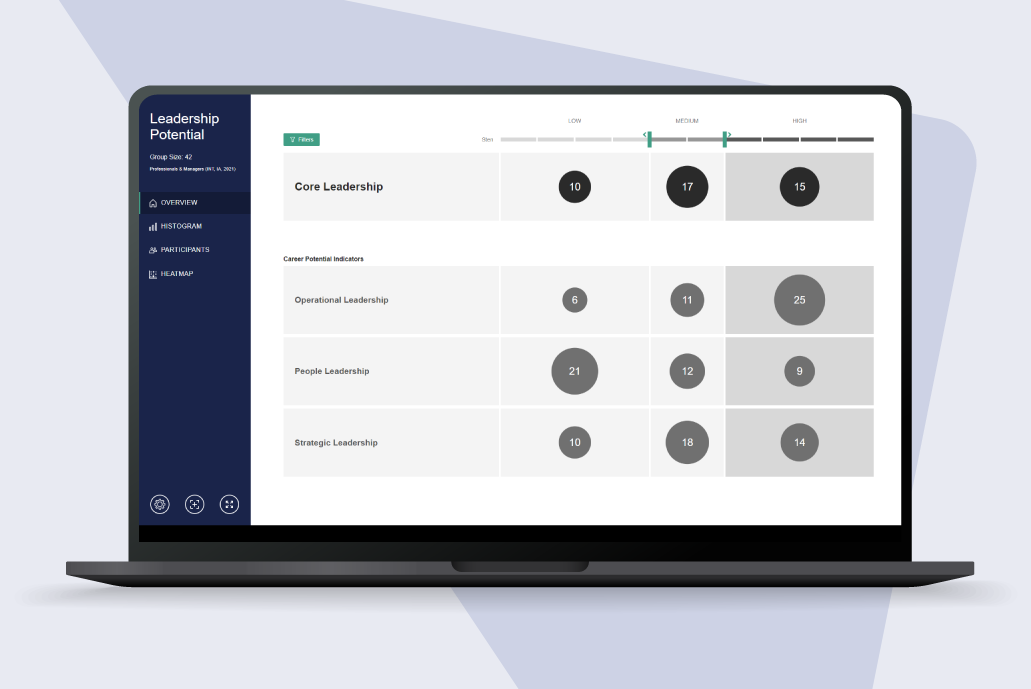
The Leadership Potential Dashboard shows potential across the organization and by division, so you can see cover for each critical role and where it runs thin.
Act and review
Calibrated talent reviews turn the evidence into decisions: development for near-ready successors, external search only where the bench is genuinely empty. Reassess on demand, not once a year.
Everything you need to evidence a succession plan
One assessment, one view of your bench, and support to run the reviews yourself.
Leadership assessment
Behavioral evidence of potential, read against your leadership model.
Leadership Potential Dashboard
Your bench across the organization and by division, on demand.
Complete once, reuse
One assessment powers succession reviews and leadership development conversations.
Feedback and training
Feedback sessions for successors, and training so your team runs reviews.
Fewer surprise vacancies
Evidenced decisions
Every name on the plan has assessment evidence behind it, so a promotion call holds up when the board asks.
- The same standard for everyone
- A record you can show
- Fewer calls made on reputation

A wider bench
Assessing the whole population, not just the nominated few, surfaces successors that managers did not put forward.
- Quiet performers seen early
- Fairer representation on the bench
- Less reliance on search firms

Live, not annual
Assess when you need to, so the bench reflects your people now rather than last year’s talent review.
- Reassess after a restructure
- Add new cohorts as you grow
- No waiting for the cycle

Easy to run
With training and support from us, your HR team reads the evidence and runs the reviews without outside help.
- Results flow into your HR system
- Feedback your team can deliver
- Support when you need it
Calculate your ROI
+5%
more women identified as having leadership potential than under the retailer’s previous 9 box approach.
International health and beauty retailer, 14,000+ employees
Hear it from our clients
“The people who have built this business will retire, and their knowledge will walk out of the door with them. Having a clear view of who can step into those roles is critical for us.”
“Saville helps us find people sooner and accelerate them.”
Succession planning questions
Straight answers to what talent leaders ask before they rebuild a succession plan.
Succession planning is the process of identifying and preparing people to step into critical roles when they fall vacant. It covers leadership and specialist roles, and it works best when readiness is judged on evidence rather than on who a manager puts forward.
There are four: name the roles where a vacancy would hurt most and define success in each; assess potential across the population; read the bench to see cover for each role; then act through calibrated talent reviews and reassess when the business changes.
Assessment gives every potential successor the same measure, so the list rests on evidence rather than visibility. It catches people who were overlooked and flags people who were nominated but are not ready, which a nomination round cannot do.
No. We supply the evidence a succession plan needs: behavioral assessment read for leadership potential, and the Leadership Potential Dashboard to see your bench. That evidence works alongside the HR system or succession tool you already use.
Succession planning covers named critical roles and who could fill them. A leadership pipeline is the wider flow of people growing toward leadership. The two use the same evidence, and most organizations need both.
It can replace the nomination round that feeds one. One international health and beauty retailer moved from an annual 9 box cycle to assessing leadership potential on demand, and identified 5% more women with leadership potential.
Show your board who is ready next
Tell us your critical roles and we will show you how to build the evidence behind them.