






Personality assessment that predicts who’ll perform
Most personality tests tell you what someone is like. Ours tells you what they will deliver at work, how well, and where they will struggle, and it cuts the odds of a serious mis-hire from 1 in 5 to 1 in 50.
THE ORGANIZATIONS THAT ASSESS PERSONALITY WITH US
What is a personality assessment?
A personality assessment is a standardized questionnaire that measures how a person tends to think, behave and stay motivated at work, scored against a norm group so you can compare people fairly.
Ours are built to predict job performance, not sort people into types. Use one to shortlist, choose between finalists, or develop and promote. Hiring managers get strengths, risks and interview questions they can act on.
1 in 5
The odds of a serious mis-hire on interview alone. Make that 1 in 50 with a personality assessment powered by Wave®.
60%
More accurate at pinpointing real development strengths and limitations with Wave®, compared with the average personality tool (Saville ROI model estimate).
$248,000
Extra sales a year, on average, from salespeople who performed well on our assessment.
What makes a personality test for work worth trusting
Three questions to ask any provider, and the answers behind ours.
Predictive validity
Does the score predict the job? Validity is how closely a result tracks what a person goes on to do at work. Wave Professional scores 0.57, among the highest independently validated figures on record, and the British Psychological Society reviewed it at 27 out of 30.
Talent and motive together
Most questionnaires measure what someone is good at. Ours also reads what they want to do more of, and the gap between the two is where development conversations get useful and where a strong-looking candidate quietly disengages.
Answers you can trust
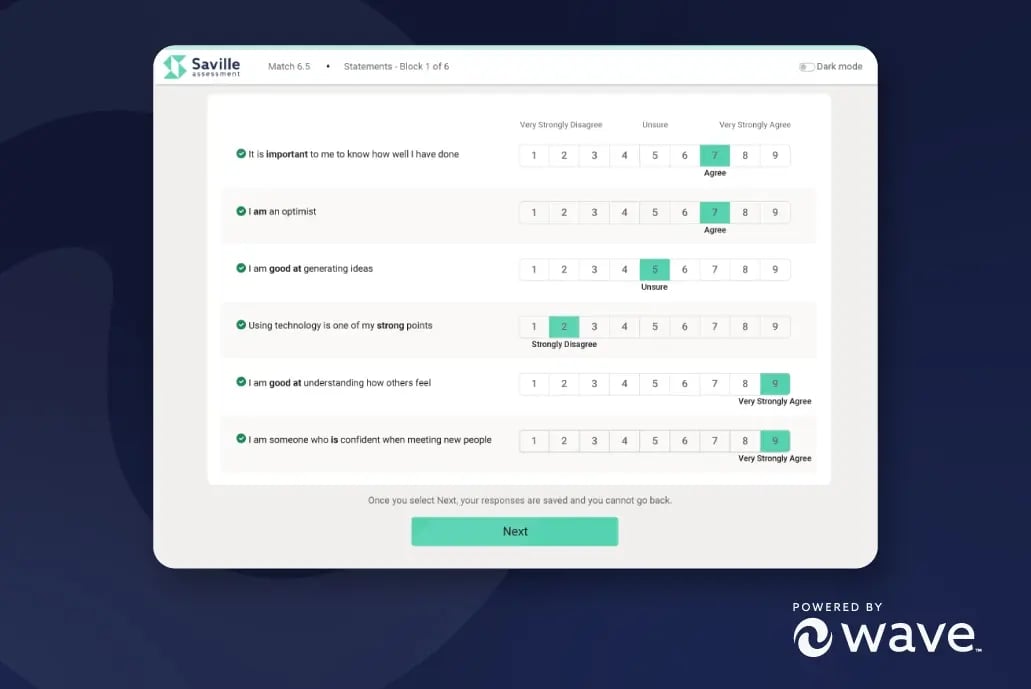
Candidates rate each statement, then rank the ones they scored the same, so claiming to be strong at everything forces a trade-off. A consistency check flags profiles that still read as overly positive or negative.
Run it on a role you are hiring now
Which type of workplace personality test do you need?
Four kinds of test sit behind the phrase. Only one of them belongs in a hiring decision.
Measure a person on continuous scales, such as the Big Five and the finer-grained dimensions beneath them, and score against a norm group. Validated against job performance, so they can be used for selection, development and succession.
Sort people into categories, such as the 16 four-letter types. Useful for self-awareness and team conversations; their own publishers say they should not be used for recruitment or selection, because a type does not predict performance.
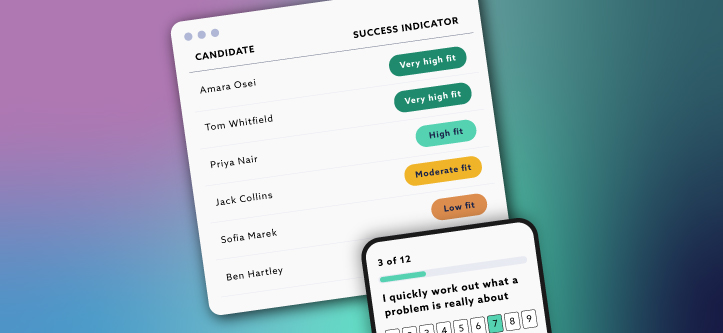
A six-minute read on working style for high-volume and early-careers roles, ranking applicants by fit so recruiters interview the right people first.
Built to assess mental health in clinical, forensic and medical settings, and administered by qualified clinicians. Not for workplace hiring, and not something we offer.
How a personality test for work is used
Three steps from role to report
1. Profile the role, with your stakeholders or with the AI success profiler.
2. Candidates complete the questionnaire online, untimed, with practice questions, adjustments and a plain explanation of how their data is used.
3. You read the report: scores against a norm group, predicted strengths and risks, interview questions, and a feedback report the candidate can keep.

Development, not just selection
The same questionnaire a candidate completed at interview keeps working after the hire. Our modeling shows Wave identifies real development strengths and limitations about 60% more accurately than the average tool, so development budget lands on the people and the gaps that move.
What a validated personality assessment changes
“Saville helps us find people sooner and accelerate them.”
Head of Assessment
Assessment where your team already works
Frequently asked questions
The questions buyers ask before their first project. If yours is not here, ask us and an expert will reply.
Yes, if it is a validated occupational questionnaire scored against a norm group and linked to a role profile. Type indicators are a different thing: their own publishers advise against using them in selection, because a type does not predict job performance.
How a person tends to behave, what motivates them and where their talents lie, on continuous scales rather than categories. Ours measures the dimensions beneath the Big Five, and reads motive as well as talent so you see what someone will do, not only what they can do.
It depends on the instrument. Wave Professional has a validity of 0.57, independently validated. In practice, an industry-standard assessment still leaves about 1 in 10 hires in the bottom fifth of performers; ours leaves 1 in 50.
It is designed to make that expensive. Candidates rate each statement, then rank the ones they scored the same, so claiming to be strong at everything forces a choice. A consistency check flags profiles that still read as overly positive or negative.
Between about six and 35 minutes depending on depth: a short screen for volume roles, a 13-minute default for most hiring and development decisions, and a 35-minute deep dive for senior appointments. All are untimed, so nobody is scored on reading speed.
Yes, and most clients do. The same profile supports onboarding, development, internal moves and succession, and our modeling puts Wave’s development impact at about four times the average tool.
Bring us a role you are hiring for
Tell us the role and the level. We will show you what the personality assessment would say about your shortlist.