






Psychometric assessment that predicts who’ll perform
Interviews tell you who interviews well. A psychometric assessment measures what a person will actually deliver, how well, and where they’ll struggle, so you hire, develop and promote on evidence rather than instinct.
TRUSTED FOR HIGH-STAKES PEOPLE DECISIONS WORLDWIDE
What is a psychometric assessment?
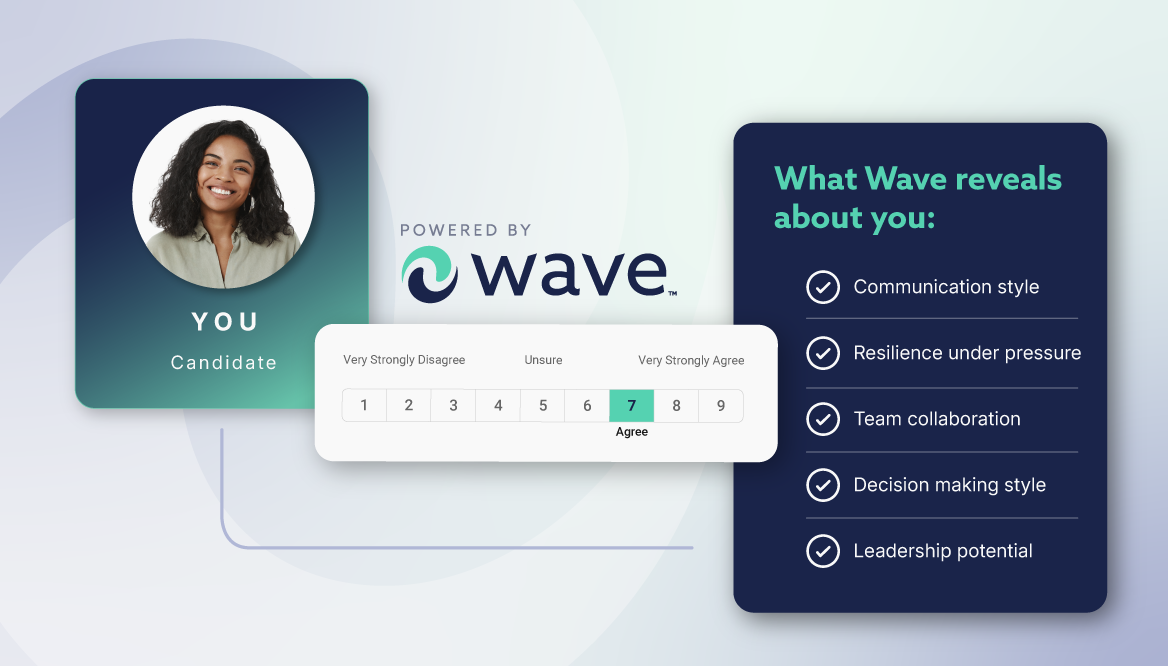
A psychometric assessment is a standardized, scientifically validated measure of how a person thinks, behaves and is motivated at work. Every candidate answers the same questions under the same conditions, and their results are scored against a norm group, so you compare people on one scale rather than on how well they interviewed.
Employers use psychometric assessments at three points: to screen large applicant pools fairly, to choose between shortlisted candidates, and to develop or promote the people they already have. The output is a report written for a hiring manager, not a psychologist: what this person will deliver, how well, and where they will need support.
1 in 5
The odds of a mis-hire when you decide on interview alone. Make that 1 in 50 with a psychometric assessment powered by Wave®.
27/30
Independent test review score from the British Psychological Society.
65%
Better at identifying key leadership traits, so potential is spotted earlier and more accurately.
What makes psychometric testing worth trusting
Three questions to ask any provider, and the answers behind ours.
Predictive validity
Does the score predict the job? Predictive validity is how closely a result tracks what a person goes on to do at work. Ours has been independently reviewed by the British Psychological Society, and the validity studies are published, not just claimed. The numbers sit on the science page.
Fairness
Does it treat every group the same? Every scale is checked for adverse impact across groups, candidates can request reasonable adjustments and extra time, and the report shows evidence rather than a verdict, so the final decision stays with a person.
Honest answers
Can candidates fake it? They rate each statement, then rank the ones they scored the same, so claiming to be strong at everything forces a trade-off. A consistency check flags profiles that still read as overly positive or negative.
See it run on one of your live roles
Which type of psychometric test do you need?
Four families of test, each answering a different question about a person. Most clients combine two.
How they’ll work. A questionnaire that measures working style, motives and talents, and predicts how someone will behave in the role. The core of most hiring and development decisions, available at three depths from a short screen to an expert-grade deep dive.
How fast they’ll learn. Timed verbal, numerical and abstract reasoning tests that measure how quickly a person takes in new information and solves problems, which matters most in complex roles.
What they’d do. Realistic work scenarios with a choice of responses, scored against what your best performers would do. Built around your roles, so candidates see the job before they join it.
Who to see first. A short behavioral and ability screen for high-volume roles that ranks applicants by fit in minutes, so recruiters spend interview time on the right people.
How psychometric testing works
Three steps from role to report
1. Profile the role. Tell us what success looks like in the job, or build the success profile from the role description with the AI success profiler.
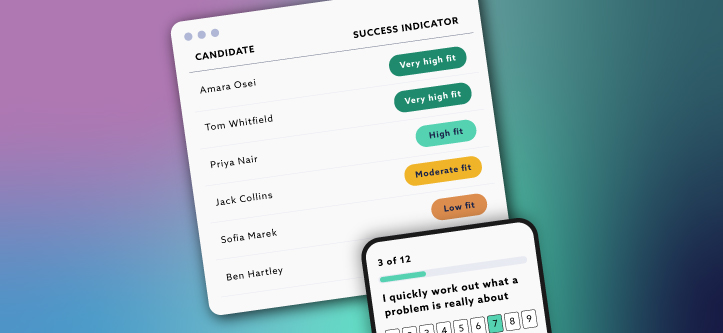
2. Candidates complete it online. Behavioral questionnaires are untimed; ability tests are timed. Candidates get practice questions, reasonable adjustments and a clear explanation of how their data is used.
3. You read the report. Scores sit against a norm group, with predicted strengths and risks for the role, interview questions to probe them, and a feedback report the candidate can keep.

Taking a psychometric assessment?
If an employer has asked you to complete a Saville assessment, start in the Candidate area. It explains what each test looks like, has free practice questions, and tells you what happens to your results. If you need extra time or an adjustment, ask the employer before you start; the platform supports both.
What a validated assessment changes
Using an optimised combination of aptitude and behavioural assessment versus aptitude alone, our data modelling showed a 44% rise in progressed minority ethnic candidates when screening at the 31st percentile.
rise in progressed minority ethnic candidates

Decision-making times cut from 3 weeks to 48 hours, with estimated cost down 70%
Estimated cost saving

Fits into how you already hire and develop

Frequently asked questions
The questions buyers ask before their first project. If yours is not here, ask us and an expert will reply.
They are the same thing in practice. “Test” usually means one timed ability measure, such as numerical reasoning; “assessment” usually means the whole exercise, which can combine behavioral, ability and situational judgment measures into one report.
Between six and 35 minutes for a behavioral questionnaire, depending on depth, and around 15 to 25 minutes per timed ability test. A full hiring battery rarely needs more than an hour of a candidate’s time.
No. There is no pass mark. Results show how a person compares with a norm group on each scale, and you decide what matters for the role. That is also why the same assessment works for development, not just selection.
Yes, when they are built and monitored properly. Every scale is checked for adverse impact across groups, candidates can request adjustments and extra time, and the report shows evidence, not a verdict, so the final decision stays with a person.
On behavioral questionnaires, candidates rank statements they rated the same, which makes it hard to present a flattering version of yourself consistently, and a consistency check flags unusual patterns. On ability tests, a behind-the-scenes safeguard flags likely AI-assisted answers, so you can still trust the scores.
Yes. Each assessment has published validity evidence, a documented link to the role profile, and a report that records the basis for the decision, which is what an employment tribunal or an equal opportunity review asks to see.
Tell us the decision you need to get right
A short note on the role or the program, and one of our consultants will come back to you with what the assessment would show.