AI now touches every step of hiring. Used well it saves real time. Left unchecked, it makes critical errors that compound, step after step, into decisions you can’t trust.
In two years AI has moved from a curiosity to the default way work gets done, on both candidate and employer sides of the hiring process. The time savings are real and immediate, which is exactly why the risks underneath are so often ignored.
of HR teams now use AI in recruitment, up from 51% a year ago
projected to be using it by 2027
of candidates now use AI to apply, and climbing
Sources: SHRM, Gartner
Here is what the efficiency story leaves out. The single biggest thing holding teams back from AI in recruiting is not cost, and not skills, it is whether they can trust what it produces. And when an unreliable tool sits at the start of a hiring process, its errors don’t stay put. They travel all the way through it.
of HR teams report significant AI impact, more than double 2023
AI is the second-biggest pressure shaping workforce decisions
name AI reliability as their top barrier to using it in recruiting
Source: Fosway Group, Talent Acquisition Realities, RecFest 2026
On our recent webinar, interview notes and transcripts were the single most common answer when we asked where AI shows up most, ahead of job descriptions, CV screening and scoring. It’s also where a quiet but critical error is least likely to be caught. Here’s what that looks like up close.
A recruiter was reviewing the AI summary notes from a batch of interviews they’d run that day when a line stopped them. The candidate, it said, brought significant experience at EY, the accountancy firm. It didn’t sound right. Nothing about EY was in the CV.
In the full transcript, what she’d actually said was UI. The AI had misheard two letters and written it up as fact, in a sentence no one ever spoke.
This one got caught. Had that summary gone to a second reviewer who wasn’t in the room, the error travels, and starts shaping a decision as if it were true. Then the question becomes: what else was misheard that nobody thought to check
Not in the CV. Not on the recording. She said “UI” not “EY”. Two letters, rewritten as a fact and passed on down the line.
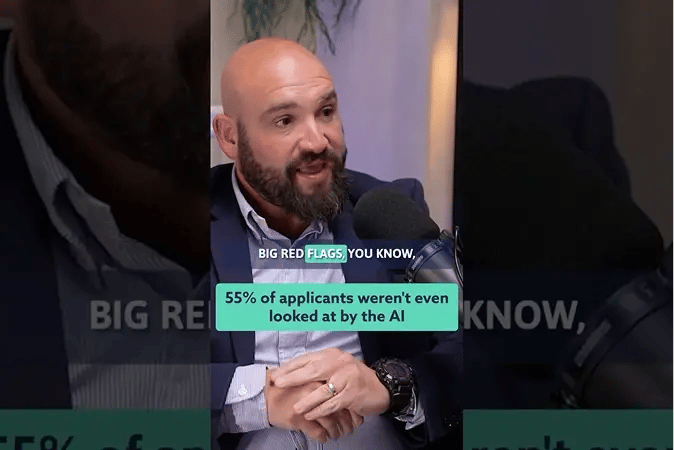
Martyn Redstone, an AI and HR compliance specialist, joined our podcast to share an experiment. He ran the same batch of CVs through three different AI screening models, every day, for three weeks. The results were hard to unsee.
Some drift is by design, these tools are built to vary their answers. But half the field going unread is a known limitation: when a model compares a hundred similar documents at once, it simply stops weighing them all.
“An LLM is, at its heart, a very sophisticated prediction machine. Most of the time that lands well. Some of the time it is confidently, fluently wrong.”
Barny Ritchley, Chief Technology Officer
It predicts plausible words. It doesn’t know your business, and it can’t reliably tell you when it’s out of its depth.
It learns from the past, so it carries the patterns and biases of the past, including the decisions you’d rather not repeat.
And it sounds just as certain either way.
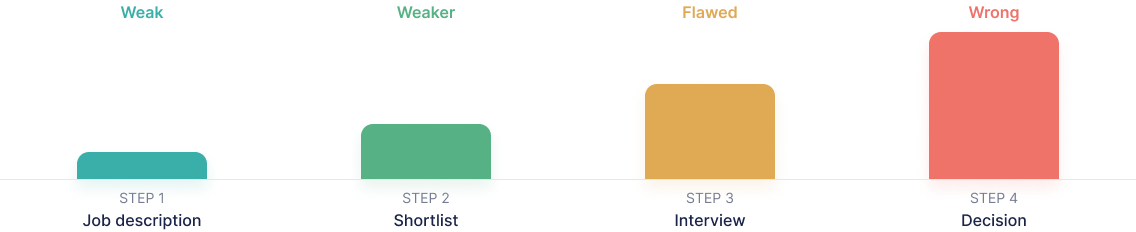
Those fractions don’t just add up. They multiply.
No single stage looks like a failure on the surface but the damage compounds with every weak touchpoint.
We asked the live audience whether good people could be slipping through their own process. The most common answer wasn’t yes, and it wasn’t no.
couldn’t be certain their process was clean
That uncertainty is the whole problem. Unreliable AI doesn’t announce itself, so you can’t fix what you can’t see. Another 13% had already watched good people slip through, and the third who told us they don’t use AI at all still have candidates who do. The rest of this report is about removing the doubt: a simple test for any AI you rely on, and a quick check of where your own process stands.
You don’t need us to find this. Here are five tells that AI is already skewing your talent data, each one you can check against your own process this week.
Same CVs, same tool, a different day, a different ranking. If it won’t sit still, it isn’t measuring the candidate
Three questions to run against any AI touchpoint in your hiring process, before you trust what it gives you.
Miss any one of these and the reliability gap opens up. Get all three right and AI becomes an asset you can stand behind.
When everyone can reach for AI, the measures that survive are the ones it can’t easily solve. Here’s why, in our own data.
The needle barely moves
In our own data, AI produces only a small lift, on some measures, in some cohorts, and never a wide jump across the board. We still see a clear spread of high, average and low performers. The likely reason is uncertainty on the candidate’s side: there’s no easy way to tell whether the answer AI gives is even correct, and sometimes it is confidently wrong. That risk is enough to put most people off leaning on it.
No answer AI can calculate
We build our SJTs so the response and scoring mechanism isn’t transparent, to a candidate or to an AI. There’s no single right answer that can be reliably worked out, so a model has nothing clean to optimize toward. It’s the design of the measure, not luck, that keeps the signal intact.
No template to copy
Formats like dynamic response mechanisms add complexity that’s hard to automate. And because the behaviors that matter shift from one role to the next, there’s no fixed AI template that guarantees a strong result for any given job. Success can’t be pattern-matched from the outside.
Most won’t even try
Solid research shows that simply telling candidates they’re being monitored for AI use measurably discourages attempts. It’s easy for an assessment provider to implement, and it removes most of the problem before it starts.
The unusual stands out
We compared how candidates respond before and after AI became widely available. Responding with AI looks measurably unusual against the normal pattern, so we can flag it back to an administrator to take a closer look, rather than being quietly misled.
Hover over the ones that sound like your process. We’ll point you to the most useful next step.
Get the first step right, keep every step reliable, and the compounding runs in your favor.
Writes for keywords, misses what predicts success
Rankings drift, half the CVs never read
Assess against a vague profile and you measure the wrong things
A minority lean on AI mid-assessment, and you can’t see who
All built on our science. Powered by Wave.
Whether you’re weighing up a new tool, your ATS, or us, these five separate reliable science from confident guesswork.
Does it predict performance, or just sound right?
Ask for the data that links the tool’s output to actual job performance. Serious providers publish it. If the answer is a case study or a testimonial rather than validation evidence, treat the score as an opinion, not a measurement.
To me, and to a regulator
Employment AI is high-risk under the EU AI Act, which means you need to be able to explain how a decision was reached. If a vendor can’t walk you through why one candidate scored above another, you inherit that gap, and the exposure that comes with it.
Deter, detect, or hope?
Candidates increasingly use AI in assessments. A serious provider will tell you how they deter it up front and detect it afterwards. “Our test is AI-proof” is not an answer, nothing is, so ask what actually happens when someone tries.
Two very different things
Many tools, most ATS matching included, rank on term frequency and keywords pulled from a job description. That’s only ever as good as the job description, and it rewards the familiar. Ask what the score is actually built on before you trust it.
Once, or continuously?
Models learn from the past and can carry its biases. Ask who audits for adverse impact, how regularly they do it, and what happens when they find something. “We don’t see bias” usually means no one is looking.