


Team development that finds what's missing
See how your team actually works: who challenges a plan, who finishes things, who keeps people together, and how to use all of it.
TRUSTED BY TEAMS BUILDING THEIR NEXT GENERATION
How team development works here
From one assessment to a team's agreed actions
ASSESS THE TEAM
Everyone completes one behavioral assessment and gets their own Work Roles report: the two roles they naturally take in a team, and the two they avoid.
SEE THE SHAPE
Three completions is enough to generate the Group Overview: all eight work roles on one wheel, how many people prefer each, and which roles nobody in the team covers.
RUN THE SESSION
A facilitated half day or full day, led by our consultants or by your own people using the Group Workshop Toolkit, built around what the overview actually showed.
AGREE THE ACTIONS
The team leaves with named actions against its least covered roles. The overview stays available, so you can re-run it after a restructure or a new joiner.
What actually changes
Fewer collisions
Most team friction is two people with the same preferred role competing for the same ground, or nobody covering it at all.
- Named, not guessed at
- Language the team keeps using
- Works on existing teams
Better decisions
A team with nobody in the Analyst role decides fast and tests nothing. The overview shows that first.
- Eight roles, not four types
- Shows crowding and gaps
- An action card per gap
Targeted spend
Development budget usually spreads evenly across a team. The overview shows where it will land and where it will be wasted.
- Aim the budget, not cut it
- Evidence for the L&D case
- Re-runs as the team changes
Everything a team needs to work better
Four parts, and each one answers a different person's question.
The individual's own read: what they bring to a team, what they overplay under pressure, and how to work with the colleague who does the opposite.
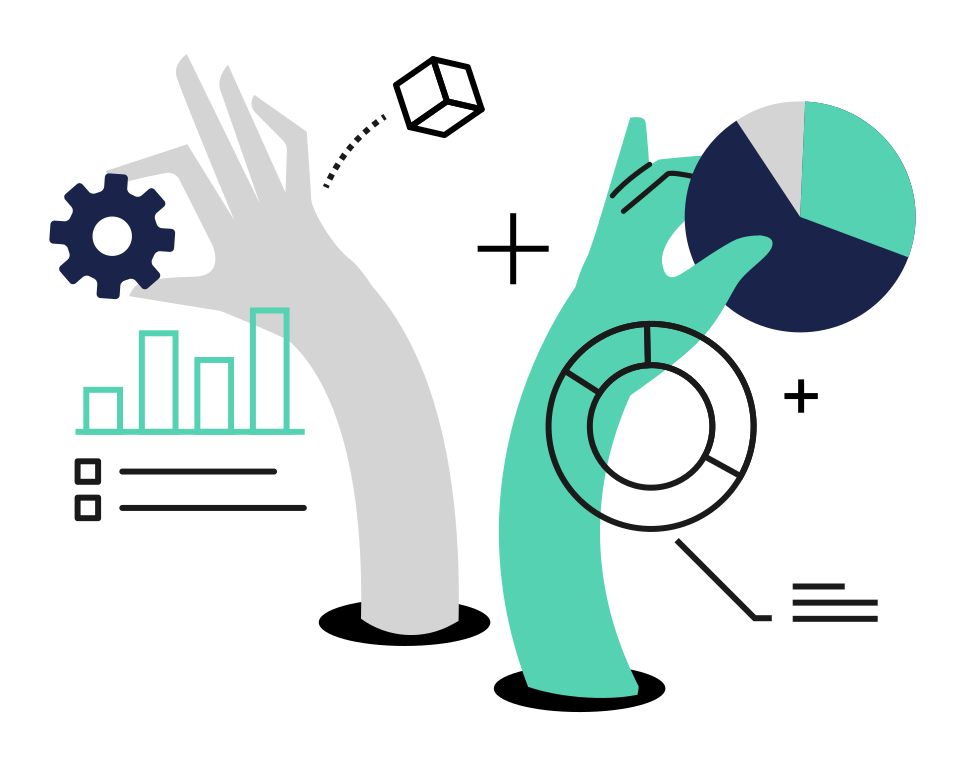
What a team leader cannot see today: where three people are competing for the same ground, and where nobody is standing at all.
The view across the business: which teams are all built the same way, and which are one departure away from a gap.
Our consultants in the room when it matters, or the toolkit your own managers use to run sessions themselves, as often as they like.
What untargeted team development is costing you
Tell us how you work out what each team member needs to develop today, how many people are involved and your industry. You will see what targeting development with Saville gives back each year in spend you stop wasting and productivity you gain.
60%
more accurately we identify where someone will actually develop, measured against an average behavioral assessment. That is the difference between development spend aimed at what will move and development spend spread evenly across the team in the hope that some of it lands.
Saville Assessment internal modelling, 2026
Two teams that had just become one
Frequently asked questions
The questions teams ask before they book a session.
Team development is the work of improving how a group of people performs together, rather than how each of them performs alone. Here it starts with a team development assessment of how each person prefers to work, then a facilitated session that turns those differences into agreed ways of working.
Three. That is the minimum for the Group Overview, and it works for teams of any size and any level above that. Most sessions run with a single intact team rather than a mixed group, because the actions need to apply to people who work together.
It measures which of eight work roles each person naturally takes: Analyst, Innovator, Relator, Assertor, Supporter, Optimist, Striver and Finisher. Those sit under four behavioral clusters. At team level it shows which roles are crowded and which nobody covers.
Yes. The Group Workshop Toolkit gives people managers and team leaders the session guide, exercises, facilitator deck and pre-session activity, with an optional train-the-trainer session. Teams that want a consultant to run it instead can book a facilitated half day or full day.
Team development starts with the assessment: your team completes it, you see the shape, and you or we run the session. Team effectiveness is the consultant-led service for situations that need someone in the room, such as a newly formed leadership team or two businesses coming together.
When the team changes. A new joiner, a departure or a restructure changes the shape of the wheel, and the overview can be regenerated with the new line-up. Teams under steady conditions typically revisit it annually alongside their planning cycle.
See your team's shape before you plan
Tell us about the team and we will show you what the overview looks like.