

HR leaders used to plan for two changes a year. They’re now navigating nine, all landing at once.
AI is rewriting how decisions get made. Junior roles are being quietly hollowed out. The Employment Rights Act is raising the cost of getting it wrong.
We sat down with Alex Bailey – organizational psychologist and CEO of Bailey & French and co-author of the excellent new book Rapid Reculturing – to work through what actually changes when the pace of work outruns the pace of humans.
AI is running ahead. Culture is falling behind. That gap is HR’s to close.
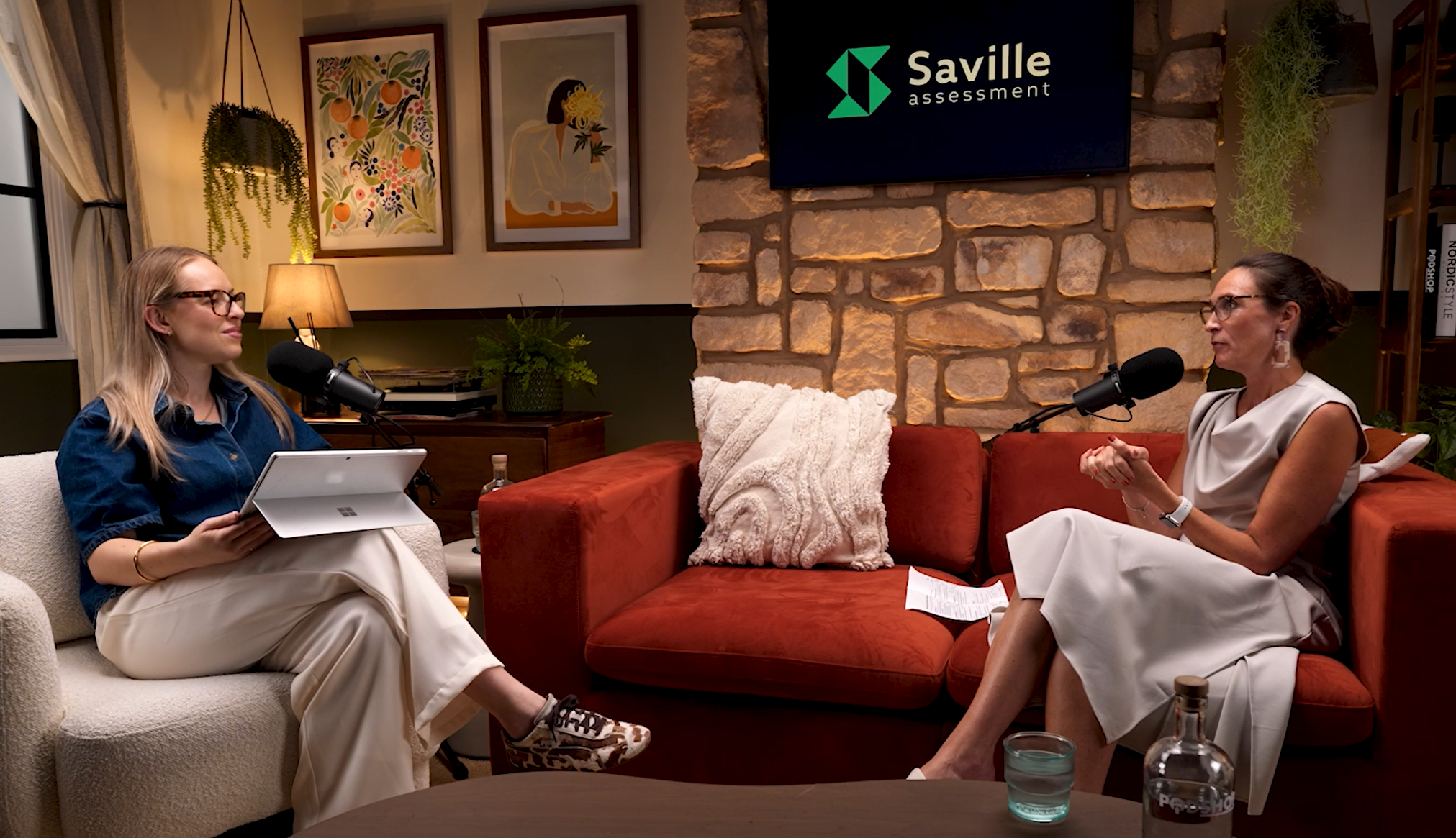

“Reculturing means to bring back the humanness to the forefront of our attention at work”
Alex Bailey

In this episode, we cover:
If you’d like to know more about this topic check out the useful resources below:



00:00:05 Sarah (Host)
Welcome to the Deep Dive, the show where we explore the hottest topics in HR assessment and the world of work.
00:00:11 Sarah (Host)
If you’ve worked in HR for any length of time, you’ll know the function is no stranger to change.
00:00:17 Sarah (Host)
But something feels different right now.
00:00:19 Sarah (Host)
AI is reshaping how decisions get made.
00:00:22 Sarah (Host)
Hybrid working has redrawn the social fabric of organizations.
00:00:25 Sarah (Host)
Junior roles are disappearing, and the Employment Rights Act brings other considerations in the UK.
00:00:30 Sarah (Host)
And against all of this, leaders are being asked to make sharper, faster, more defensible people decisions than ever.
00:00:37 Sarah (Host)
So today, we’re asking the question, is this the hardest error for HR, maybe ever?
00:00:43 Sarah (Host)
And if it is, what does the response look like?
00:00:45 Sarah (Host)
To unpack it, I’m joined by Alex Bailey.
00:00:48 Sarah (Host)
Alex, welcome.
00:00:50 Sarah (Host)
Alex is an organizational psychologist, executive advisor, and CEO of Bailey and French, where she’s worked with senior leaders navigating complexity, pace, and uncertainty for over 2 decades.
00:01:01 Sarah (Host)
She’s also the co-author of a new book that’s titled Rapid Reculturing, Transforming Organizations at Pace and Scale, written with Kerry O’Neill, Chief People Officer at Ipsos UK and Ireland.
00:01:15 Sarah (Host)
Alex, welcome to the Deep Dive.
00:01:16 Sarah (Host)
Thank you so much for being here.
00:01:17 Sarah (Host)
We really appreciate having you.
00:01:19 Alex Bailey
Thanks for inviting me.
00:01:20 Alex Bailey
It’s a good opportunity.
00:01:21 Sarah (Host)
Yeah, we can’t wait for this conversation.
00:01:24 Sarah (Host)
In your own words, would you like to introduce the audience to you and a bit about what you’ve been doing?
00:01:29 Alex Bailey
Yeah, sure.
00:01:30 Alex Bailey
So I started out as an occupational psychologist.
00:01:33 Alex Bailey
I worked internally for organisations in large global roles.
00:01:36 Alex Bailey
So for Norwich Union, for American Express, for Aviva in that financial services industry.
00:01:41 Alex Bailey
And I did some consulting with like Coca-Cola, Pfizer, Sony.
00:01:44 Alex Bailey
So really nice, big, large organisations on a cultural level.
00:01:49 Alex Bailey
And then set up my own organisation after having my two daughters.
00:01:54 Alex Bailey
And since then, we’ve been working right the way across the world, all industries, public and private sector, really looking at the commonalities of leadership challenges and cultural challenges in organisations of all size, right the way across the world, and able to really look at that human level of what’s really affecting us as humans in the workplace.
00:02:14 Alex Bailey
You know, so many people on this planet work and spend most of their life doing so.
00:02:20 Alex Bailey
You know, it’s really important that we do as much as we can to help people
00:02:24 Alex Bailey
you’re fulfilled so that it’s not just about a paycheck, but it’s actually about a way of living and a way of living that’s great and sustainable.
00:02:32 Sarah (Host)
I love that so much.
00:02:33 Sarah (Host)
It really resonates and obviously extremely topical at the moment, so I can’t wait to get a little bit more into your perspective.
00:02:40 Sarah (Host)
We’ve called this episode HR’s Defining Era, which might sound a little bit provocative.
00:02:46 Sarah (Host)
But from your position, working really closely with senior leaders for over 2 decades, how does that hold up?
00:02:52 Sarah (Host)
Is the pressure genuinely different for leaders now?
00:02:56 Alex Bailey
Totally.
00:02:57 Alex Bailey
Everything has changed.
00:02:58 Alex Bailey
It feels to me like a real crisis point.
00:03:02 Alex Bailey
And because the crisis point centers around people, HR is at the forefront of the pressure in terms of what do we do now?
00:03:11 Alex Bailey
And I think it’s very easy for us to automatically fall back on things that have worked for us in the past, maybe 5, 10, 15 years ago.
00:03:19 Alex Bailey
But the world isn’t the same.
00:03:20 Alex Bailey
It is so, vastly different.
00:03:22 Alex Bailey
And yes, it’s AI, but it’s more than that.
00:03:24 Alex Bailey
It’s the mergers and acquisitions market.
00:03:27 Alex Bailey
It’s the global backdrop, the landscape, society.
00:03:30 Alex Bailey
political changes, there’s so many different aspects of change affecting us.
00:03:34 Alex Bailey
And we’re so much more connected than we ever were.
00:03:36 Alex Bailey
So all of those things affecting us affect us much closer on a daily basis.
00:03:41 Alex Bailey
So it is a completely different world that we’re living in, and people are looking to HR to understand how do we fix that?
00:03:47 Sarah (Host)
Yeah, you’re right.
00:03:48 Sarah (Host)
It’s completely unfamiliar.
00:03:49 Sarah (Host)
And I think a lot of what you’re describing can and has felt so overwhelming to so many people, especially leaders.
00:03:56 Sarah (Host)
How have you, I guess, advised people to navigate that unfamiliarity?
00:04:01 Alex Bailey
I fall back on a statement that one of my hero psychologists used, and I’ve used it repeatedly, Dr.
00:04:09 Alex Bailey
Margaret Wheatley.
00:04:11 Alex Bailey
She talked about the world feeling unsolvable and unstoppable.
00:04:15 Alex Bailey
And I think that really sums up how it feels right now.
00:04:19 Alex Bailey
And so in response to that, obviously, in my work, in all aspects of my work, as well as my writing as well, it’s really focusing in on noticing what actually matters, what matters to us as humans, because the pace of the world is picking up and the pace and demands of people in the workplace
00:04:38 Alex Bailey
is so much more increased than it ever was.
00:04:40 Alex Bailey
We used to face maybe two changes in a year in large organizations.
00:04:44 Alex Bailey
So we could stage them out perfectly.
00:04:45 Alex Bailey
We could say, right, we’ll do the restructure and then we’ll do the IT transformation.
00:04:48 Alex Bailey
But now we’re looking at 9 changes on average in a year, which means that they’re all stacking and layering together.
00:04:54 Alex Bailey
Everything’s changing at once.
00:04:55 Alex Bailey
So you can’t time things perfectly.
00:04:57 Alex Bailey
You can’t manage, cope and recover in the same way.
00:05:00 Alex Bailey
We have to have much more of an open mindset.
00:05:03 Alex Bailey
And so one of the top ways that we support organizations or that I work with leadership teams is around developing that psychological flexibility to be more adaptable on a daily basis to this ever-changing, unsolvable and unstoppable world.
00:05:18 Sarah (Host)
Yeah, well, because I mean, especially for those organizations in quite high stakes environments, which you work a lot with, the pressure is then so much more as well.
00:05:28 Sarah (Host)
And I think the pressure to feel like you’re doing everything and managing everything well
00:05:33 Sarah (Host)
making the right decisions is immense.
00:05:36 Alex Bailey
It is.
00:05:36 Alex Bailey
And it’s felt like the screws have got tighter this last two years, particularly.
00:05:40 Alex Bailey
Performance is so much more scrutinized than ever before.
00:05:44 Alex Bailey
And it’s because, you know, economic change.
00:05:45 Alex Bailey
There has been, you know, more difficulty in the UK, but right the way across the world in different economies.
00:05:52 Alex Bailey
And what that means is organisations have to have more competition, they have to perform better, and that means people have to be better on a daily basis.
00:05:59 Alex Bailey
But you can’t just be better.
00:06:01 Alex Bailey
You have to really think about what are the skills that we’re building, how are we building sustainable wellbeing alongside performance so that people can learn and grow over time.
00:06:10 Alex Bailey
And it’s not just high performing individuals that are burning out kind of
00:06:14 Alex Bailey
on a sporadic basis whilst we’re kind of churning through.
00:06:17 Alex Bailey
And essentially, that’s a really big issue now with the additional scrutiny that is coming and already here in this world environment.
00:06:26 Sarah (Host)
Yeah, I was going to say, are you seeing a lot of that burnout happening?
00:06:30 Alex Bailey
It’s an interesting question.
00:06:32 Alex Bailey
I talk about burnout so much.
00:06:33 Alex Bailey
And it’s interesting because burnout has just become now a word that lots of people use for lots of different things.
00:06:38 Alex Bailey
You know, there is a scale of burnout, but traditionally burnout was when you could no longer do anything, no longer work.
00:06:44 Alex Bailey
And when you’ve seen people truly burn out from a clinical perspective, they no longer work.
00:06:48 Alex Bailey
You know, there’s any aspect of work triggers it to reoccur.
00:06:52 Alex Bailey
Often people end up on medication and unable to join the careers that they’ve developed over many, many years and decades.
00:06:58 Alex Bailey
So, there’s a severity to real burnout, but it’s become a topic that people use in the workplace for just being tired or just being, really worn out through, continuous change and not feeling supported.
00:07:11 Alex Bailey
So I think it’s being used in different ways now.
00:07:15 Alex Bailey
You can’t just simply recover from burnout with a two-week holiday.
00:07:18 Alex Bailey
And if that’s the case, then you may just be a little bit tired.
00:07:22 Alex Bailey
So, you know, there’s a really kind of responsible use of the language around burnout that I think is important in workplaces.
00:07:28 Alex Bailey
to really recognise what that actually means and how severe it is.
00:07:33 Alex Bailey
But also recognise that new generations into the workplace, we’ve got 4 generations in the workplace now, five in some, actually are much more aware of their own health, mental, physical, financial, all kinds of different aspects of health and actually are much more tuned into when things aren’t going well and pulling themselves back before it gets too far, which is fantastic, right?
00:07:55 Alex Bailey
Because they’ve learned looking at their parents and other generations going
00:07:58 Alex Bailey
going through really difficult times, that they’re not going to put themselves in those situations.
00:08:02 Alex Bailey
So there’s quite an interesting dynamic happening with multi-generations in the workforce at the moment that is really driving some of that understanding of what burnout really looks like.
00:08:11 Alex Bailey
So yes, I’m seeing it.
00:08:12 Alex Bailey
I’m seeing it probably more so at senior leadership levels, where leaders are shouldering responsibility for so much at once.
00:08:22 Alex Bailey
And normally that level burnout happens overnight.
00:08:25 Alex Bailey
It’s something that’s been going on for such a long time that people get to breaking point and you don’t see it coming.
00:08:31 Alex Bailey
They’re normally very highly engaged people rather than the disengaged crew.
00:08:35 Alex Bailey
And they are the people who just feel that the level of responsibility to keep things going and to support others so much that actually eventually they cannot do that work.
00:08:44 Alex Bailey
So there’s a kind of different understanding in the workplace going on right now.
00:08:47 Sarah (Host)
That makes complete sense.
00:08:49 Sarah (Host)
And I think I really agree.
00:08:52 Sarah (Host)
with you mentioning the use of, I guess, the term burnout, but also that there doesn’t seem to be a clear shared language about what that is, what that looks like, and how all of this change is impacting that as well.
00:09:05 Sarah (Host)
And I think something that’s having an even greater impact on
00:09:09 Sarah (Host)
our ability to keep up and maybe avoid burnout and do more, but then also put so much more pressure on us as well is AI.
00:09:16 Sarah (Host)
And I know people at home will be rolling their eyes because they’re bringing AI off again and everyone is, but it’s one of those tools that has simultaneously allowed us to do so much more while putting the pressure on so much more as well.
00:09:30 Sarah (Host)
And I’ve seen mentions of the intelligence age rather than just AI on your book’s webpage.
00:09:38 Sarah (Host)
Could you tell us a little bit more about that and what the intelligence age actually is with AI?
00:09:44 Alex Bailey
It’s easy to associate everything with AI, but what AI actually is fueling is something really different in the workplace.
00:09:51 Alex Bailey
And what we’re seeing is, you know, it’s not just a new tool that can kind of 10X our work output.
00:09:57 Alex Bailey
It’s something that’s going to 40 or 50x our work output.
00:10:00 Alex Bailey
And that is fundamentally different.
00:10:03 Alex Bailey
That ability to have your digital twin arrive and hold a meeting for you, make decisions and take actions and report back to you is something on another level.
00:10:14 Alex Bailey
It tests all kinds of things in our culture.
00:10:16 Alex Bailey
And I think that’s what I mean by the intelligence age is actually we are moving into a different space where AI will no longer be just a simple tool that’s the newest tool on the block.
00:10:27 Alex Bailey
but actually kind of a cultural operating system where it’s supporting the culture that exists in the organization.
00:10:32 Alex Bailey
At the moment, they’re being held quite separately, but actually the intelligence age is really about moving into that era where we’re using everything that’s available to us, but also promoting and supporting, amplifying the humanness within the system and making sure that that’s not lost.
00:10:49 Alex Bailey
So there’s a huge, that’s a huge shift going on right now.
00:10:53 Alex Bailey
And
00:10:54 Alex Bailey
Currently, because the pace of AI and the pace of tech feels like it’s continuously accelerating, that’s getting everyone’s conscious focus and attention.
00:11:05 Alex Bailey
But what we’re really trying to focus in on here is that humans have a speed.
00:11:10 Alex Bailey
Now, humans can’t just continuously go at the speed of AI.
00:11:14 Alex Bailey
We have a speed that’s comfortable and sustainable and realistic for sustainable performance with the use of everything we have around us.
00:11:23 Alex Bailey
So it’s really about not trying to constantly chase the AI speed, but actually recognize what’s the optimum human speed and the level of intelligence that we can operate with within all of this system to support culture, to support humans working in that culture, as well as using everything we have available to us.
00:11:41 Alex Bailey
for sustainable performance.
00:11:43 Sarah (Host)
Yeah, it’s an interesting point because I think it sounds like a part of what you’re saying is that people also need to have an understanding of themselves to know how to use those tools and how to implement them in a way that
00:11:57 Sarah (Host)
is helpful and not a hindrance.
00:11:59 Sarah (Host)
And I suppose when it comes to the development of teams as well, is that to remove the fear, people almost need to look at it in a different way to what they have been before.
00:12:09 Alex Bailey
Absolutely.
00:12:10 Alex Bailey
So yeah, 100%.
00:12:11 Alex Bailey
Because if you think about, I mean, we use the emotional intelligence model at the core of a lot of our work and our design work, because
00:12:18 Alex Bailey
As human beings, we are a species on this planet that also has a tendency to grow.
00:12:24 Alex Bailey
So throughout our lives, we grow and we naturally develop more emotional intelligence as we age.
00:12:29 Alex Bailey
But we can accelerate and amplify that through particular programs and awareness.
00:12:33 Alex Bailey
But it all starts with that self-awareness and then developing our other awareness and our management of ourselves and relationships.
00:12:39 Alex Bailey
But that self-awareness is being really challenged, I think, and particularly over the last six, seven years with the changes in the workplace, it’s really been making people kind of examine their identity and think about who they are very differently as human beings.
00:12:53 Alex Bailey
So true.
00:12:54 Alex Bailey
And so a lot of, certainly a lot of the work that we’ve done or that I’ve done in the last kind of two decades around emotional intelligence, you know, leading self, leading others, leading the organisation, that foundation,
00:13:05 Alex Bailey
It was all quite solid.
00:13:06 Alex Bailey
I think everybody knew that.
00:13:07 Alex Bailey
And by the time they’d kind of hit a certain age in the workplace, they’d done their leading self part and they were onto the leadership stages.
00:13:13 Alex Bailey
And I think what the last six, seven years has done is kind of ripped that up and said, no, identity is something we really need to understand differently.
00:13:21 Alex Bailey
We need to understand what our authentic self is.
00:13:23 Alex Bailey
How do we bring our best self into work being authentic, but being professional?
00:13:27 Alex Bailey
How do we ensure that we’re actually being inclusive when we’re developing our authentic understanding of those around us?
00:13:34 Alex Bailey
And then the AI curveball of being asked to understand what does this new era mean for us in terms of our identity?
00:13:45 Alex Bailey
Because if you can have a digital twin, then who am I?
00:13:48 Alex Bailey
And that’s a really, I mean, that’s a huge big question that we haven’t really tapped into very much.
00:13:52 Alex Bailey
Everyone’s quite excited about the tech.
00:13:54 Alex Bailey
And once you explore it and you experiment with it, it’s fantastic.
00:13:58 Alex Bailey
But I think sometimes the subconscious humanness is being forgotten and lost.
00:14:02 Alex Bailey
And I see that’s what’s happening with culture.
00:14:04 Alex Bailey
So that’s a large part of the book that we explore in the first part.
00:14:07 Sarah (Host)
Yeah, that’s actually quite interesting because I was thinking about how when it comes to the introduction of AI or these new tech tools, there’ll be some leaders that are embracing it, some that are a bit nervous and some that are completely trying to avoid it.
00:14:21 Sarah (Host)
What do you think the psychology is behind that?
00:14:23 Sarah (Host)
Do you think people haven’t had that question of identity brought up to them before?
00:14:28 Sarah (Host)
How do you think they’re thinking about it?
00:14:30 Alex Bailey
I think it depends which generation you sit within.
00:14:33 Alex Bailey
If I’m honest, I think there’s different generations approaching this from very different ways.
00:14:38 Alex Bailey
And I think certainly kind of…
00:14:41 Alex Bailey
In my era, in my generation, we did a lot of work on leading self and understanding ourselves and Jahari’s windows and all these kinds of interesting ways of understanding ourselves, psychometrics, for example.
00:14:52 Alex Bailey
So it feels like you’ve kind of done that work and we’ve moved on.
00:14:55 Alex Bailey
And I think for those generations, actually, it is a bit of a, whoa, hang on a second.
00:14:59 Alex Bailey
this is a different world.
00:15:00 Alex Bailey
I need to re-examine who I am and what I want in this world.
00:15:03 Alex Bailey
And I speak a lot for women leaders as well, particularly who have owned their own businesses and found as entrepreneurs.
00:15:09 Alex Bailey
And for me, you know, there’s a large, certainly a large network of women in the kind of mid-age cycle that are really examining identity and talking about it very differently than we used to be able to talk about that in the workplace kind of 10, 20 years ago.
00:15:24 Alex Bailey
And I think that’s a great conversation that’s coming up and actually making more people talk about
00:15:29 Alex Bailey
identity more broadly.
00:15:30 Alex Bailey
And I think that’s great.
00:15:32 Alex Bailey
But I think new generations to the workplace are thinking about identity completely differently.
00:15:37 Alex Bailey
And I look at my children that, they’ve grown up with a device in their hand that’s constantly giving them feedback on how they are, how many likes they’ve got with different pictures and songs they’ve put online or, you know, who they’ve been speaking to and how many network people are in their network.
00:15:50 Alex Bailey
And I never had that growing up.
00:15:52 Alex Bailey
So I didn’t have that input to my identity.
00:15:55 Alex Bailey
So they’re much more attuned to very small, fine things.
00:15:59 Alex Bailey
And I think that’s really interesting.
00:16:00 Alex Bailey
So if I ask my parents, they’ll not necessarily know what’s a scam and what isn’t a scam in terms of the tech kind of field.
00:16:07 Alex Bailey
My children, they absolutely can detect a scam 1,000,000 miles away.
00:16:12 Sarah (Host)
So they feel for it.
00:16:13 Alex Bailey
They have this just different understanding of that landscape.
00:16:17 Alex Bailey
And I think that also has just a huge impact on who you are and your identity.
00:16:22 Alex Bailey
Similarly, as I said, my parents, you know, they would think about themselves differently in terms of how people speak to them on Facebook, for example, or similar platforms.
00:16:29 Alex Bailey
than my children using other completely different platforms and what’s feeding their identity from those.
00:16:35 Alex Bailey
So they’re using them differently to understand their identity.
00:16:38 Alex Bailey
And I think there’s, yeah, there’s just…
00:16:42 Alex Bailey
There’s so much more out there than there ever was.
00:16:44 Alex Bailey
But I think it is a turning point.
00:16:46 Alex Bailey
I think people are asking more questions now than there have been.
00:16:49 Alex Bailey
I think there’s so many crises that happened from 2020 around the pandemic that people almost took several years to almost come back to understand, okay, now what does this really mean for me?
00:17:00 Alex Bailey
Who am I into this new world of work, this new era?
00:17:04 Sarah (Host)
Do you see any conflict in that, like the different generations approaching things differently and having a different, I suppose, mindset around how these things should be implemented in our lives?
00:17:16 Sarah (Host)
Do you see any conflict come up in that from a leadership perspective or even just a way of approaching things, like people strategy, for example?
00:17:27 Alex Bailey
I think feedback is taken differently.
00:17:30 Alex Bailey
So
00:17:32 Alex Bailey
I would see that new generations and certainly the younger generations that I work with are much more finely attuned to the use of language in texts, in Teams messages, in emails, than perhaps other generations that are much more aware of positioning or facial expressions or, you know, how people engage and how they actually behave with you in person.
00:17:59 Alex Bailey
And I think there is a very different level of social development happening in the online space that actually is not reflected in the real world.
00:18:10 Alex Bailey
So we see people kind of absolutely brilliantly connecting online, but unable to have a really full and exploratory conversation in person because there’s different barriers that are appearing.
00:18:21 Alex Bailey
So yeah, I think there are some really huge differences.
00:18:24 Sarah (Host)
Yeah, it’s interesting.
00:18:25 Sarah (Host)
That made me think of the classic generational tug with the thumbs up emoji.
00:18:31 Sarah (Host)
And when people are sending
00:18:33 Sarah (Host)
sending Teams messages or whatever.
00:18:35 Sarah (Host)
And I always think that’s a classic kind of conflict point for someone that is a tech native and has this feeling that the thumbs up emoji is something that’s passive, whereas someone that’s older sees that as something that’s, you know, just affirming whatever you’ve said.
00:18:50 Sarah (Host)
And it’s interesting how tone and language and context has changed so much and is so different online compared to in person.
00:18:59 Sarah (Host)
And we’re starting to see some big enterprise organizations now hollow out junior roles as AI absorbs the entry-level work.
00:19:08 Sarah (Host)
Invariably, that affects talent pipelines and the pool of future leaders.
00:19:14 Sarah (Host)
Is there a risk that we end up with AI-augmented senior teams, but no bench underneath them?
00:19:22 Alex Bailey
100%.
00:19:23 Alex Bailey
We absolutely are heading in that direction.
00:19:26 Alex Bailey
And we’re almost in my eyes to a certain extent, many, many people are sleepwalking into that.
00:19:31 Alex Bailey
And it’s not through, it’s not through lack of anything other than just being under so much pressure that you’re not aware of what we’re walking into because we’ve got so much to do.
00:19:42 Alex Bailey
We are constantly being asked to do more with less on every single level.
00:19:46 Alex Bailey
The large corporates, the small businesses, you know, we don’t have the resource, the time, the budgets,
00:19:53 Alex Bailey
to be able to put into the things that are in front of us and the opportunities.
00:19:57 Alex Bailey
So the prioritization is critical of what does happen and what doesn’t happen, the explanation of what is prioritized versus what is deprioritized.
00:20:06 Alex Bailey
but actually the conscious focus on ensuring that we are actually bringing new generations into the workforce and supporting them to do the work in great ways is really important.
00:20:17 Alex Bailey
And it worries me when I interview people and graduates for roles with us and I talk to them and they’ve been actively discouraged to use AI throughout their degrees.
00:20:28 Alex Bailey
And so they’re nervous to use it in the workplace at a point when we are fully experimenting and exploring what can AI do with everything?
00:20:35 Alex Bailey
Can it tell me what
00:20:36 Alex Bailey
I should be focusing on today, looking at my inbox.
00:20:38 Alex Bailey
Can it tell me how to design and do a huge piece of data analysis on data sets we’ve been gathering for years that we’ve never done anything with?
00:20:45 Alex Bailey
You know, what can it do for me?
00:20:47 Alex Bailey
And the kind of waiting for permission and the nervousness around conflict is then meaning that people are holding back and hesitating.
00:20:55 Alex Bailey
So even when leaders are making decisions and taking decisive action,
00:20:59 Alex Bailey
and expecting teams to move forward on that.
00:21:02 Alex Bailey
Actually, there’s a lot of stalling going on where people are nervous about, hang on, am I going to do this?
00:21:07 Alex Bailey
Am I going to get into trouble if I do it wrong?
00:21:09 Alex Bailey
What’s the failure expectation here?
00:21:13 Alex Bailey
And yeah, and you know, it’s a tricky landscape to be part of because there is, there’s regulation, there’s legislation that means we can and can’t do things.
00:21:21 Alex Bailey
And if we don’t understand the full context, how can we pass some of those?
00:21:26 Alex Bailey
those activities onto people who maybe haven’t worked in that environment before.
00:21:30 Alex Bailey
There’s a huge amount of risk.
00:21:31 Alex Bailey
So risk intelligence is becoming more important, actually.
00:21:35 Sarah (Host)
Yeah, definitely.
00:21:36 Sarah (Host)
You mentioned sleepwalking into it.
00:21:38 Sarah (Host)
Do you have any examples of where you’ve seen that directly and how maybe someone’s gone about fixing that or maybe not?
00:21:48 Sarah (Host)
And that’s just they’re continuing to sleepwalk.
00:21:50 Sarah (Host)
How have you seen that manifest in a real world situation?
00:21:55 Alex Bailey
I mean, I’ve had conversations with people who are aware that they are taking steps that are basically better for them, but not better for the newbies in the organisation.
00:22:08 Alex Bailey
So, a fantastic new AI system is able to give you details at your fingertips.
00:22:15 Alex Bailey
maybe on some research that’s required for a next role, a next meeting in the afternoon, but actually to give that to someone else to explain to them what you need to get them to set it up on their computer and go ahead and find the results actually takes more time.
00:22:29 Alex Bailey
And where that used to be helpful and important, because that would mean they learn and develop and they’re able to then take on those bigger pieces.
00:22:36 Alex Bailey
Actually, you can do it yourself with AI, copy them in, make sure that they’ve seen the details of what prompts you’ve used.
00:22:41 Alex Bailey
And it’s like a shortcut for the demands and the needs of the clients and the customer that is then driving almost this pace, this acceleration of must do more quicker, faster.
00:22:54 Alex Bailey
That is actually forcing us to feel that we don’t have much choice.
00:22:58 Alex Bailey
But that’s happening with leaders right the way across the board.
00:23:00 Alex Bailey
I’ve even found myself doing it when I’m thinking, gosh, but actually if we can get other people doing the same thing and we can get new generations using AI much quicker and bringing in new innovation and inviting and welcoming them to use things in a different way and creating the safe boundaries and the opportunities, then actually we could see so much more come out.
00:23:25 Alex Bailey
But yeah, we’re safeguarding ourselves at the moment, I think, a little too much.
00:23:28 Sarah (Host)
I would agree with that.
00:23:29 Sarah (Host)
And I think as the pace ramps up, the risk intelligence conversation becomes so much more relevant.
00:23:36 Sarah (Host)
How do you see that being balanced?
00:23:38 Sarah (Host)
Is there a balance between those two things?
00:23:41 Alex Bailey
I think the balance is hard.
00:23:42 Alex Bailey
From what I see leaders do, if they don’t get the right communication from the team about the actions that they are taking on board, and they are nervous about the risk that perhaps they know their team
00:23:54 Alex Bailey
doesn’t have sight of, that’s when they jump in and take over and it feels very disempowering.
00:24:00 Alex Bailey
So I think there’s a very interesting kind of pendulum swinging of empowerment and disempowerment at the moment in organizations where
00:24:08 Alex Bailey
People are trying, but then they’re getting kind of almost the rug pulled out underneath them when they suddenly realize they’re trying to do something in an environment with risks they weren’t aware of and the leader has to step in and kind of rescue.
00:24:20 Alex Bailey
But that can feel very disempowering.
00:24:22 Alex Bailey
And if it’s not explained in terms of what’s being prioritized and what isn’t being prioritized or the risks that actually are there that perhaps they hadn’t seen, for those individuals, that can feel like an issue for psychological safety.
00:24:35 Alex Bailey
So we’re getting a lot, as I said, we’re getting a lot of this pendulum swinging between kind of like, I really want the empowerment, I want the accountability to go and innovate and do great things.
00:24:43 Alex Bailey
But if I’m not aware of the environment enough to make those decisions myself for a large organization, and there’s bigger risks to me doing that, is it just going to be taken away from me the next day?
00:24:52 Alex Bailey
And when that happens, is that me flagging and saying, well, there’s no psych safety here.
00:24:57 Alex Bailey
And I think that’s where there needs to be some balance, some middle ground where essentially the answer is to communicate better.
00:25:04 Alex Bailey
We just need to talk to each other, explain why decisions are being made, explain why things aren’t happening.
00:25:10 Alex Bailey
I think that’s one of the key things that I’m seeing at the moment is that a lot of leaders are explaining why things are happening.
00:25:16 Alex Bailey
Here’s the decision I’ve made, but they’re not talking about what’s being deprioritized.
00:25:21 Alex Bailey
And that means that people just hear what needs to happen on top of everything else they’re already doing.
00:25:26 Alex Bailey
And so then it just feels like another load rather than actually I need to do this instead of some of the things that I was doing.
00:25:32 Alex Bailey
So there’s that kind of opportunity there for leaders to really be just better at communicating and sharing out loud.
00:25:39 Alex Bailey
This is why I’m making this decision.
00:25:40 Alex Bailey
This is what it’s based on.
00:25:41 Alex Bailey
This is what we’re prioritizing now.
00:25:43 Alex Bailey
This is what we’re deprioritizing.
00:25:45 Alex Bailey
Here’s how you can step in.
00:25:46 Alex Bailey
Here’s what I’d like to see from you.
00:25:48 Alex Bailey
These are the clear expectations of what’s ahead.
00:25:53 Sarah (Host)
Yeah.
00:25:53 Sarah (Host)
I think understanding what you’re deprioritizing is a really interesting point and one I haven’t seen brought up either.
00:26:01 Sarah (Host)
We’re hoping soon to have Kerry join us herself for the next pod in a month or so’s time.
00:26:07 Sarah (Host)
And it’ll be interesting to get her take on the AI transformation piece as well, especially given her work on the AI advisory board for CIPD.
00:26:15 Sarah (Host)
But from your own lens, what do you think is the one area in the HR and talent space that you
00:26:22 Sarah (Host)
would never let AI anywhere near.
00:26:25 Sarah (Host)
Is there a space?
00:26:27 Alex Bailey
Yeah, so I guess I’m more concerned about the small business population using AI for difficult situations and employee relations cases where perhaps lots of small businesses don’t have the luxury of having a specific HR person in those organizations.
00:26:46 Alex Bailey
And it’s so much easier to use Copilot for everything right now.
00:26:50 Alex Bailey
that relying on that without a backed kind of legal influence can mean that it empowers leaders to have conversations, particularly with the Employee Rights Bill, changing lots of different things over time.
00:27:04 Alex Bailey
It can actually empower leaders to have conversations that might lack the humanness that’s required in those scenarios.
00:27:12 Alex Bailey
So we’ve continuously worked with organisations to try and remove the instances of grievances and proactively develop a culture and
00:27:20 Alex Bailey
conversations in the working environment, that means we don’t get to those legal cases.
00:27:24 Alex Bailey
We actually nip things in the bud.
00:27:25 Alex Bailey
You have conversations before it gets to a difficult mediation.
00:27:29 Alex Bailey
But we’re seeing so many organizations now dealing with many more grievances and people feeling, you know, that they want to themselves use co-pilot to help them put their case together.
00:27:42 Alex Bailey
And it’s maybe more
00:27:45 Alex Bailey
informed than previously.
00:27:46 Alex Bailey
And actually that means that things have to be taken quite seriously.
00:27:50 Alex Bailey
So I think we are coming into a very strange space where that’s somewhere I wouldn’t use AI so much.
00:27:57 Alex Bailey
I would very much rely on the human that has the understanding of the entire situation and the context.
00:28:03 Sarah (Host)
That’s very interesting.
00:28:04 Sarah (Host)
It almost sounds like AI is now, or it could create, AI could create a lack of defensibility in decisions.
00:28:15 Alex Bailey
I don’t think there’s a minefield of what it can and can’t do.
00:28:18 Alex Bailey
And yeah, I value so much the HR consultants that I’ve ever worked with in my career.
00:28:27 Alex Bailey
And I’ve got a good understanding of HR kind of legal issues, but to be able to speak to someone who really understands and got experience of going through, as I said, the human experience of it, that is, you know, there’s no way that AI can talk to that, not in the same way.
00:28:43 Sarah (Host)
Do you think HR leaders are fully aware of how the cost of getting it wrong is shifting because of AI?
00:28:51 Alex Bailey
Maybe, not just yet.
00:28:53 Alex Bailey
I think, you know, I don’t…
00:28:55 Alex Bailey
I’d say it’s still pockets.
00:28:56 Alex Bailey
Not everyone is using AI effectively or in all areas of their role and maybe just using it more as kind of an assistant than actually kind of augmenting it into everything they do.
00:29:07 Alex Bailey
So I think we’re in a really interesting window actually where there’s a real mix of use.
00:29:14 Alex Bailey
So it’s hugely exciting for people who are experimenting and leading the way to go ahead and explore and do things before everybody else.
00:29:21 Alex Bailey
There’s also a wind of opportunity of businesses to compete and to level the playing field using AI in a different way to actually get much further ahead than previously.
00:29:30 Alex Bailey
You know, you can write an entire marketing campaign in a day.
00:29:34 Alex Bailey
You know, there’s so much opportunity to do things that weren’t possible before.
00:29:39 Alex Bailey
And then I think there will be a time when everyone is there and then all of a sudden the expectations are going to change.
00:29:44 Alex Bailey
I mentioned before from kind of 10xing to 40xing, all of a sudden the world of work is going to change.
00:29:49 Alex Bailey
Clients and customer expectations are going to completely change and the demands are going to be just as high because they’ll be expecting it from everyone.
00:29:57 Alex Bailey
So it’s going to be an interesting time.
00:30:00 Sarah (Host)
Yeah, completely.
00:30:01 Sarah (Host)
I was just thinking as you were talking, you know, there isn’t a day that goes by where I don’t have multiple
00:30:07 Sarah (Host)
tabs open on with an AI platform helping me do any kind of task.
00:30:13 Sarah (Host)
And now multitasking is a much more normal part of my day and can happen at rapid pace like it hasn’t before.
00:30:23 Sarah (Host)
And there are interesting risks even in the quality of your work that come through in that.
00:30:28 Sarah (Host)
And I work in a marketing function, so that impacts me in different ways, but I’m sure in an HR function, to your point, making people decisions or trying to get guidance on people decisions, there’s a lot of risks that can come up there.
00:30:41 Sarah (Host)
And your work centres quite a lot on those high-stakes environments, like we mentioned earlier.
00:30:46 Sarah (Host)
What do you think separates organisations in that space that consistently make good decisions under pressure from those who don’t?
00:30:54 Alex Bailey
I’m certainly sure that the new field we’ve been kind of exploring and researching around psychological flexibility has a huge impact.
00:31:03 Alex Bailey
So what we’re seeing is that leaders who are able to accept the new reality quickly and accept how they feel about that reality.
00:31:11 Alex Bailey
So yes, it might be frustrating that everything they’ve worked on for three years has come to a halt all of a sudden.
00:31:17 Alex Bailey
Yes, it might be frustrating that their budget has been redirected elsewhere.
00:31:20 Alex Bailey
Yes, it might be frustrating that they’re going to have to restructure next week
00:31:23 Alex Bailey
and they’ve just grown the team, big challenges.
00:31:26 Alex Bailey
The quicker that leaders can emotionally accept that reality and then distance themselves and look at the evidence and the facts of what’s really going on to make very clear decisions in the present moment without worrying about the past or worrying about the future, but also anchoring those in values that matter to themselves and their team.
00:31:46 Alex Bailey
That is where I see the big differentiation leaders who are able to actually lead with organisational agility.
00:31:53 Alex Bailey
And we’re doing a lot of work at that level, kind of CEO and executive level around that human agility and the speed of being able to make decisions under such immense pressure.
00:32:05 Alex Bailey
in large corporations, it’s millions of pounds a day that are at risk.
00:32:10 Alex Bailey
And they need to be able to draw on all of their resources to be able to do that.
00:32:16 Alex Bailey
And all of these things in isolation aren’t particularly new, but together, actually, it accelerates the pace with which people
00:32:23 Alex Bailey
people can make decisions in the moment.
00:32:25 Alex Bailey
And that is what’s going to be competitive for organisations going into the future is the speed with which they can respond to change and transformation.
00:32:32 Alex Bailey
Because there’s no handling or managing it differently that’s going to make a difference.
00:32:35 Alex Bailey
It’s got to be about that speed.
00:32:37 Sarah (Host)
That’s interesting.
00:32:38 Sarah (Host)
So do you think it’s that agility piece that sits mostly behind making poor decisions?
00:32:42 Sarah (Host)
Is there anything else that…
00:32:43 Alex Bailey
Yes, because, you know, ultimately, as a leader, you have to know what information you need to make a decision.
00:32:49 Alex Bailey
You have to be able to make a decision without all the complete information as well.
00:32:54 Alex Bailey
And you need to know what the implications of those decisions are and how to make good trade-offs.
00:33:00 Alex Bailey
Because ultimately that’s the biggest thing that stalls decision making.
00:33:03 Alex Bailey
And once you’re a leader that doesn’t make decisions, people go elsewhere for information or they disengage.
00:33:08 Alex Bailey
And that’s on a large scale, that’s just super dangerous.
00:33:11 Alex Bailey
That’s where the culture can kind of drag and the energy slows down massively in your organization.
00:33:17 Alex Bailey
So yeah, it’s very important to ensure that leaders are very, very clear about how they can make decisions and move forward through those quickly.
00:33:26 Sarah (Host)
Thinking about engagement actually,
00:33:29 Sarah (Host)
If I read out the statement, I want to hear if it resonates with you.
00:33:33 Sarah (Host)
A good future of work shows a good level of engagement between employer and employees.
00:33:39 Sarah (Host)
How does that sound to you?
00:33:40 Alex Bailey
Fine, but not particularly exciting.
00:33:43 Alex Bailey
And I think that’s the thing.
00:33:44 Alex Bailey
You know, we talk about a lot in the book about this difference between kind of engagement and energy.
00:33:50 Alex Bailey
Engagement is important, but it really is a measure.
00:33:54 Alex Bailey
It’s just one measure in an organization.
00:33:57 Alex Bailey
of how people are, but it doesn’t really tap into the energy.
00:34:00 Alex Bailey
And so we talk to leaders a lot about how the culture feels.
00:34:05 Alex Bailey
And that’s very different to asking someone to give you the survey details and responses.
00:34:10 Alex Bailey
So being able to say, how does your culture feel?
00:34:13 Alex Bailey
How are people in meetings?
00:34:15 Alex Bailey
And people will often say to us, actually, we’ve got really great engagement scores, but something feels really off.
00:34:20 Alex Bailey
I can’t put my finger on it.
00:34:22 Alex Bailey
And if you ask, a senior leader and you say, where does the energy sit in your organization?
00:34:27 Alex Bailey
They’ll be able to say, absolutely, they know where it is.
00:34:30 Alex Bailey
Actually, we’ve got, you know, this one team, they’re working on this new thing.
00:34:33 Alex Bailey
They’re so excited.
00:34:34 Alex Bailey
They’re always asking questions.
00:34:35 Alex Bailey
They’re curious.
00:34:36 Alex Bailey
They’re moving at pace.
00:34:37 Alex Bailey
You know, the energy signals we’re getting from that area are huge.
00:34:42 Alex Bailey
But across the organization, we’re seeing change, resistance, we’re seeing tiredness.
00:34:47 Alex Bailey
We’re seeing, you know, exhaustion, burnout in particular areas.
00:34:52 Alex Bailey
And that’s an indication that actually they might still be engaged, love their work, but just don’t have the vitality to continuously sustain their performance doing it.
00:35:03 Alex Bailey
And that’s, they’re two very different things.
00:35:06 Sarah (Host)
It’s really interesting to hear your take.
00:35:07 Sarah (Host)
That was a quote we heard at.
00:35:09 Sarah (Host)
HR Technologies Conference earlier in the year.
00:35:13 Sarah (Host)
And one of the sessions had mentioned data highlighting a broad sense of public dissatisfaction across a range of areas.
00:35:19 Sarah (Host)
And I also think engagement has come up a lot.
00:35:21 Sarah (Host)
I think it was in the Gallup state of work research as well around how it’s at record lows.
00:35:28 Sarah (Host)
So I think it’s a really interesting
00:35:31 Sarah (Host)
topic.
00:35:32 Sarah (Host)
And from what we’ve seen from early glimpses of your book, you’re proposing to reframe that energy as you’ve spoken about.
00:35:39 Sarah (Host)
And I suppose something that energy has impacted a lot or something that has impacted that energy a lot is the hybrid workplace.
00:35:47 Sarah (Host)
And that is a topic that has divided people massively.
00:35:50 Sarah (Host)
What’s the verdict today around five years post-COVID?
00:35:54 Sarah (Host)
Like what do you see?
00:35:55 Sarah (Host)
from that perspective around the hybrid workforce?
00:35:57 Sarah (Host)
Is that having an impact on energy?
00:35:59 Alex Bailey
Yes, hugely.
00:36:01 Alex Bailey
And it might be controversial for me to say it because obviously there are so many people that enjoy the benefits of working more flexibly from different environments.
00:36:10 Alex Bailey
But from what I see, it’s one of the, almost like the quiet, slow erosions.
00:36:17 Alex Bailey
of human connection because you don’t know what you’re missing out on.
00:36:22 Alex Bailey
And I think that’s where you can prioritize and focus in on yourself and your own environment and your pets in your home and connecting to people when you want to and being off and on and not having to be constantly bombarded or distracted.
00:36:35 Alex Bailey
But actually the fabric of human connection is something that’s subconscious.
00:36:40 Alex Bailey
And so you’re not necessarily thinking about that when you’re thinking about where you want to work.
00:36:45 Alex Bailey
You’re thinking about what’s right for you, but not really thinking about those threads that are so critical and fundamental.
00:36:51 Alex Bailey
From what I’ve seen in organisations, that’s had a huge impact on culture in the last five, six years.
00:36:58 Alex Bailey
And on managing and leading, we’ve got first time managers now moving into those roles and into leadership roles who’ve never worked in an office environment and never worked in the room with other people in their team.
00:37:12 Alex Bailey
So they’ve learnt managing and leading in that online digital environment, which has
00:37:19 Alex Bailey
And as I said, it lacks the human connection that comes from, noticing very small, tiny things and non-verbal communication.
00:37:28 Alex Bailey
But we’ve deprioritized it because other things felt better at the time.
00:37:32 Alex Bailey
But what that means is people are focused in on their work and their silos.
00:37:35 Alex Bailey
And it doesn’t matter how many different platforms and connection kind of tools that we have,
00:37:42 Alex Bailey
there’s nothing quite like what it feels like to be in a room full of people.
00:37:46 Alex Bailey
So we’re seeing this year a huge resurgence of people getting together in events in the room.
00:37:53 Alex Bailey
Leadership events, summits, all organization events, because
00:37:57 Alex Bailey
you feel something different as a human when you’re in a room.
00:38:00 Alex Bailey
You go to a concert with 10s of thousands of people, the energy that exists in that environment, with the music, with the laughter, with the smell, with everything that you’re experiencing as a living thing.
00:38:14 Alex Bailey
And I think we forget that sometimes we are a living species.
00:38:18 Alex Bailey
And we talk about, all the different other living species on this planet in a very different way than we talk about ourselves.
00:38:23 Alex Bailey
We have needs.
00:38:24 Alex Bailey
We have needs that are creative for art, for music, that actually fuels us and fuels our energy.
00:38:30 Alex Bailey
And we need to bring more of that into the workplace in a way that actually fuels performance and sustainable performance, because that’s what wakes us up and gives us meaning.
00:38:38 Alex Bailey
And it doesn’t need to be woo-woo.
00:38:39 Alex Bailey
We get a lot of that.
00:38:40 Alex Bailey
It’s kind of like, how do we talk about energy?
00:38:42 Alex Bailey
But like, can we just not do the woo-woo thing?
00:38:44 Alex Bailey
Because no one wants to go down that route.
00:38:45 Alex Bailey
I’m not talking about sitting and holding hands or singing anything together.
00:38:49 Alex Bailey
You know, I’m really talking about tapping into, you know, who in the room has got curiosity?
00:38:55 Alex Bailey
Who is awake enough to think that actually the pathway we’re going down with this project isn’t quite right.
00:39:00 Alex Bailey
There’s something that feels off.
00:39:01 Alex Bailey
Say it.
00:39:02 Alex Bailey
If it feels off, tell us what is it feels off.
00:39:04 Alex Bailey
But if people are just going through the motions, they’re not really engaged, they really haven’t got energy because they’re exhausted, they’re not going to ask those questions.
00:39:12 Alex Bailey
And that’s what we mean by energy in the workplace.
00:39:14 Alex Bailey
It’s about that ability to be flexible in the moment and to be awake and alive in the workplace.
00:39:22 Alex Bailey
And that’s, it’s disappearing.
00:39:25 Sarah (Host)
It completely resonates on a personal level.
00:39:28 Sarah (Host)
I used to work completely remote for
00:39:31 Sarah (Host)
2 1/2 years.
00:39:32 Sarah (Host)
And I would say by the end of it, I was the least energetic, least motivated person I’d been in quite a while.
00:39:40 Sarah (Host)
And I was just desperate for that in-person collaboration and connection again, because when you are in a room brainstorming and you’re able to work together and physically, you know, put post-its on a wall or whatever, like do those things,
00:39:54 Sarah (Host)
that are tangible and physical with other people.
00:39:56 Sarah (Host)
I agree.
00:39:57 Sarah (Host)
I think it leads to a completely different type of motivation, energy, engagement.
00:40:03 Sarah (Host)
And it helps teams build effectiveness in a way that they may not have been able to otherwise.
00:40:10 Alex Bailey
Yeah, you know, the relationships and the dependencies we have on other humans are so important and so huge.
00:40:16 Alex Bailey
You know, again, Meg Wheatley talks about having to have islands of refuge, islands of sanity for ourselves as leaders, as team members.
00:40:24 Alex Bailey
And those people that you build in your web of support is your island of sanity.
00:40:27 Alex Bailey
when you’re sitting there doing something and you’re on a call and you hear something and you turn around to someone next to you and you go, did you hear that as well?
00:40:33 Alex Bailey
Did I hear that right?
00:40:34 Alex Bailey
I mean, are you serious?
00:40:36 Alex Bailey
but you don’t have a chance to do that at home.
00:40:38 Alex Bailey
It’s this kind of sense making, this double checking.
00:40:40 Alex Bailey
Are we still here on this planet together?
00:40:42 Alex Bailey
Are we actually doing this project in the right way?
00:40:44 Alex Bailey
Did we miss something?
00:40:45 Alex Bailey
Like being able to double check and reinforce builds confidence and allows you to be the best person you can be.
00:40:50 Alex Bailey
But if you don’t have that there, it can be so such an omission.
00:40:55 Alex Bailey
And it’s just such an easy thing to not realize you haven’t got.
00:40:58 Alex Bailey
So it’s that problem almost of trying to just bring our awareness back to the fact that as human beings, we need each other.
00:41:05 Alex Bailey
We are social beings.
00:41:06 Alex Bailey
We are interconnected.
00:41:07 Alex Bailey
We are interdependent.
00:41:08 Alex Bailey
You know, we absolutely need to be social.
00:41:12 Alex Bailey
And if we don’t have enough opportunities to do that, if we just, you know, save that for our yoga class or for our night down the pub,
00:41:18 Alex Bailey
then actually we’re missing out the fabric of the workplace that knits those teams together to be able to support each other in hard, challenging times.
00:41:25 Alex Bailey
And work is hard.
00:41:27 Alex Bailey
Work is uncomfortable pretty much every day, right?
00:41:29 Alex Bailey
And it’s not going to be this wonderful panacea of happy joy.
00:41:33 Alex Bailey
And I think, you know, the realization that actually you can have so much fulfillment working through a challenge together and really supporting other people through that is something I think we need to bring back, definitely.
00:41:43 Sarah (Host)
I love that so much.
00:41:46 Sarah (Host)
And another big thing we haven’t really touched on yet is talent mobility.
00:41:50 Sarah (Host)
Why has it become so central and what does good look like now?
00:41:54 Alex Bailey
Talent mobility, that’s a huge one.
00:41:57 Alex Bailey
So I think we have more of a focus on skills in the workplace than ever before.
00:42:03 Alex Bailey
And I’m really pleased about that because I used to work in organizations where there were hundreds of competencies and
00:42:08 Alex Bailey
People didn’t really know what the difference was between a competency, a capability, a behaviour.
00:42:12 Alex Bailey
It all kind of blended into one and it was quite difficult and murky to kind of work out.
00:42:16 Alex Bailey
But I think now that actually people have got more understanding of what’s the difference between like knowledge and skills and what’s the difference between skills and strengths.
00:42:24 Alex Bailey
And I think we understand those differentiations so much more that we can actually define what skills are for different roles and look at what transferable skills are.
00:42:32 Alex Bailey
allow more mobility within organisations so that people can find different career paths and can grow in lots of different shapes and ways that are more aligned to who we are and our strengths as well.
00:42:43 Alex Bailey
And I think that’s exciting.
00:42:46 Alex Bailey
I think also the focus on inclusion means that people are much more excited about diversifying how people do roles and where people do roles and who works together and how teams operate and more matrix opportunities actually opens things up
00:43:02 Alex Bailey
for people to apply their skills into different ways of working in lots of different scenarios.
00:43:08 Alex Bailey
So I think that’s more exciting for talent mobility, for sure.
00:43:13 Alex Bailey
And I hope that helps actually with some of the, as I said, the stalling that AI is causing with new generations in the developing the bench.
00:43:22 Sarah (Host)
I’ve been getting carried away with my own questions.
00:43:23 Sarah (Host)
I think they’re very interesting.
00:43:25 Sarah (Host)
I’ve loved hearing your perspective.
00:43:28 Sarah (Host)
So obviously, above everything, we’ve established that there’s a lot happening right now.
00:43:33 Sarah (Host)
Teams and leaders are looking for answers.
00:43:35 Sarah (Host)
And your new book suggests that reculturing might just be the way forward.
00:43:41 Sarah (Host)
So let’s talk about it.
00:43:42 Sarah (Host)
Firstly, how did the book come about with Kerry?
00:43:45 Sarah (Host)
And then also, if you’re able to walk us through what reculturing actually means in practice.
00:43:51 Alex Bailey
Yeah, so
00:43:54 Alex Bailey
I’ve known Kerry for 20 years.
00:43:56 Alex Bailey
So we worked together way back when in Aviva on some amazing cultural work.
00:44:02 Alex Bailey
And at the time, we both put our souls into the work that we were doing.
00:44:09 Alex Bailey
We were incredibly highly engaged and had huge opportunity to explore and innovate with just incredible, incredible groups of people in the organisation around us, which meant that
00:44:23 Alex Bailey
we were able to move and make some big shifts.
00:44:26 Alex Bailey
And I think that just really informed both of us from the outset what’s possible in large-scale global organisations, about 27 countries, 65,000 people.
00:44:35 Alex Bailey
I think it really put us on a path to then we’ve both
00:44:40 Alex Bailey
We’re great friends.
00:44:41 Alex Bailey
We both kind of stayed connected through very different career paths since that point.
00:44:46 Alex Bailey
So Kerry stayed in internal roles and grew rapidly through her career into a fantastic award-winning Chief People Officer.
00:44:56 Alex Bailey
And she has led such huge transformational programmes within organisations.
00:45:01 Alex Bailey
Often with legislative pressure, that creates urgency and complexity and global impacts.
00:45:13 Alex Bailey
And actually, I took the opposite kind of route and went obviously into developing my own consultancy, working with hundreds of organisations across the world.
00:45:21 Alex Bailey
So she’s kind of got that deep insider knowledge, internal perspective on the barriers and the operational models and systems that takes so much away from, you know, transformation programmes when you’re trying to really shift a system.
00:45:34 Alex Bailey
So she’s got all of that really rich insight and understanding.
00:45:37 Alex Bailey
And I’ve kind of worked across the spectrum, really looking at what are the commonalities
00:45:42 Alex Bailey
What are the universal challenges across thousands of leaders worldwide that actually always come up as the big things?
00:45:49 Alex Bailey
So it can bring those insights in across industries into where we’re looking at.
00:45:53 Alex Bailey
And we were both seeing the same thing and talking about it for years.
00:45:56 Alex Bailey
So
00:45:58 Alex Bailey
it was really just over two years ago that we had a conversation and said, should we just go ahead and write the book then?
00:46:04 Alex Bailey
And we both already captured all different parts of the book over many years.
00:46:08 Alex Bailey
And my first kind of outline, a sketch of some of the parts of the book, I’ve actually, I remember dating it July 2007, because I remember putting it on there thinking that’s the first time I’ve put this down on paper.
00:46:22 Alex Bailey
And so it’s taken that long for us to develop, but I think that time has infused all of our thinking into the practical application, both internally and across large scale organizations.
00:46:32 Alex Bailey
So this is not just about one change.
00:46:34 Alex Bailey
This is not just about 1 transformation.
00:46:36 Alex Bailey
This is about 20 years of internal and external consultancy, looking at the whole system, what’s wrong with the whole landscape, the worlds that we operate within, HR, with occupational psychology, with industrial psychology, with strategic priorities, demands and the change
00:46:52 Alex Bailey
changing global economies.
00:46:54 Alex Bailey
So yeah, the book’s come out over the last couple of years.
00:46:57 Alex Bailey
Once we started writing, we kind of wrote it quite fiercely and it was chapter after chapter and we wrote one book and then we wrote the next book, which is part one.
00:47:04 Alex Bailey
So we kind of created something quite big, quite quickly and yeah, really pleased, but I’m very proud actually of how it came together.
00:47:13 Alex Bailey
But in terms of the book, Reculturing, we use that word really
00:47:18 Alex Bailey
is so important because it is about kind of renewing and redoing this and refreshing and bringing things to a point where we really elevate and recognise the humanness that’s needed in the organisation.
00:47:30 Alex Bailey
So we focus in on some really important drivers of culture that perhaps have been misunderstood or perhaps not recognised as the most important ones.
00:47:41 Alex Bailey
But actually in our experience, there are four key drivers that have had the biggest impact on cultures the world over.
00:47:47 Alex Bailey
Firstly, is purpose, which gives people meaning.
00:47:50 Alex Bailey
And it’s so fundamental.
00:47:52 Alex Bailey
It’s in so many different pieces of evidence-based research.
00:47:55 Alex Bailey
We know it from the science that purpose is fundamental.
00:47:58 Alex Bailey
In culture, we have to feel like we are working to be part of something bigger than ourselves.
00:48:04 Alex Bailey
And that is a driver that is really universal.
00:48:07 Alex Bailey
So that’s really critical.
00:48:09 Alex Bailey
The collective mindsets is about having more flexible, collective direction.
00:48:17 Alex Bailey
So mindsets are very different than having principles or values that are kind of stuck and quite rigid.
00:48:22 Alex Bailey
Mindsets we can choose to change at any moment in any day.
00:48:27 Alex Bailey
But we can come together as a group of leaders and say, right, we’re going to focus on this month with a mindset to get things done, which means that this month we are not going to invite everyone to every meeting.
00:48:39 Alex Bailey
We’re going to take decisions and we’re going to own it and we’re going to explain why we’ve made those decisions and what we’ve deprioritized as a result.
00:48:45 Alex Bailey
But we’re going to move quicker because we’re going to move and make decisions much more rapidly without involving everybody, but we’re going to explain things differently.
00:48:53 Alex Bailey
So it’s about how do we choose that mindset that’s in line with our strategy and our purpose and keep shifting them.
00:49:00 Alex Bailey
But the collective mindset actually keeps the organization on its toes.
00:49:04 Alex Bailey
And that culture of having collective mindsets together allows us to not be so worried about offending people with different values.
00:49:12 Alex Bailey
because we all have different values.
00:49:14 Alex Bailey
For generations in the workplace, we’re not going to share values.
00:49:17 Alex Bailey
We don’t have shared values anymore.
00:49:18 Alex Bailey
And organisational values are nice to sign up to, but often, you know, the people who don’t agree with them just won’t say anything.
00:49:24 Alex Bailey
They’re just quietly disengaged.
00:49:25 Alex Bailey
So we don’t really even know.
00:49:27 Alex Bailey
So, you know, it’s nice to have, but they don’t actually do a lot for culture.
00:49:32 Alex Bailey
So culture refresh programmes are based around values.
00:49:36 Alex Bailey
have very minimal impact on culture.
00:49:38 Alex Bailey
And I think the shift to thinking about mindsets as a real action driver is quite a new thing.
00:49:45 Alex Bailey
Energy is really about momentum.
00:49:51 Alex Bailey
So catalysts, about being able to recognise where energy is and use it within the organisation to transfer across teams, across projects, across different systems.
00:50:01 Alex Bailey
noticing where people are taking new bold steps and celebrating that and praising it, recognising it, rewarding it so that actually it transfers.
00:50:11 Alex Bailey
Opening up new ways of talking in town halls, in larger group meetings so that people can actually feel something different.
00:50:19 Alex Bailey
and feel that they are part of something and bringing that much more to the forefront so that people don’t feel so worn out by change all the time, but feel those excitement points and the joy and the humour that can come with trying something new every day.
00:50:32 Alex Bailey
You know, it can be a fun thing and it’s about tipping things and flipping them into a situation where it’s not so draining, but actually fueling our energy to keep going.
00:50:43 Alex Bailey
And then that last piece is around human connection, and that’s about cohesion.
00:50:47 Alex Bailey
We’re not made to do this life alone, any of us.
00:50:52 Alex Bailey
And the more we bring that back to the forefront and help people recognise that, yeah, we can have tons of very flimsy online connections,
00:51:01 Alex Bailey
and followers and all of that.
00:51:03 Alex Bailey
But actually, we know who are the people we’re closest to, people we rely on, the people we need by us when we’re facing challenge.
00:51:10 Alex Bailey
And that is the connection and the cohesion that humans need in the workplace.
00:51:13 Alex Bailey
So it’s about focusing on those four drivers as cultural drivers.
00:51:17 Alex Bailey
And then the rest of the book is really the skills playbook of how do you shift a culture in such a large organisation.
00:51:24 Sarah (Host)
That’s such a refreshing take, honestly.
00:51:27 Sarah (Host)
I think it’s a really interesting concept and I can see exactly how moving forward from something as rigid as values, which just by definition feel like they have to stay the same and can’t change, to mindsets, yeah, that definitely resonates with how it feels natural to approach work and change, especially.
00:51:49 Sarah (Host)
If you could put any chapter into
00:51:51 Sarah (Host)
every board member’s hands, which one would it be?
00:51:55 Alex Bailey
I would say right now, it would probably be in part one, we talk about why reculturing.
00:52:01 Alex Bailey
So it’s really the business case, the context, what’s going on right now.
00:52:05 Alex Bailey
If I’m honest, I think it is quite confrontational.
00:52:08 Alex Bailey
And I think that’s what board leaders need right now, because I think culture and people have been underfunded in organizations.
00:52:17 Alex Bailey
It’s been kind of passed on to small kind of activity groups, engagement activity groups, or, you know, other kind of groups that have been set up without much responsibility or budget or actually much influence in the organization to influence the culture.
00:52:31 Alex Bailey
And that’s not really what’s needed right now.
00:52:33 Alex Bailey
So I think for me, it would be that upfront
00:52:36 Alex Bailey
kind of confrontation of where the world is right now and what’s going to happen if we don’t reculture really quickly.
00:52:41 Alex Bailey
So that’s why it’s rapid reculturing.
00:52:42 Alex Bailey
We absolutely need to do this rapidly because AI is moving so fast.
00:52:47 Alex Bailey
If we don’t pick up the pace on the human side of things, we’re going to lose the humanness in our organizations.
00:52:53 Alex Bailey
And that’s going to have a massive impact on particularly some of the larger organizations, I think, first, in a way that perhaps they hadn’t expected.
00:53:01 Alex Bailey
So, you know, I think we need to be on our toes.
00:53:04 Alex Bailey
And I think a lot of board leaders know that, but they haven’t quite put the finger on it yet.
00:53:08 Alex Bailey
And I think that’s what that first few chapters really brings to the forefront.
00:53:12 Sarah (Host)
Yeah, incredible.
00:53:13 Sarah (Host)
This is definitely a book everyone needs to get in their hands.
00:53:16 Sarah (Host)
And we are excited to say that we’ve got a few copies to give away.
00:53:19 Sarah (Host)
So more info on that in the show notes.
00:53:22 Sarah (Host)
Definitely stay tuned for that as well.
00:53:26 Sarah (Host)
So before you go, I want to make sure we get through some quickfire questions.
00:53:30 Sarah (Host)
Sure.
00:53:33 Sarah (Host)
Yes, be as honest as possible.
00:53:35 Sarah (Host)
So #1, reculturing in one sentence.
00:53:38 Sarah (Host)
Go.
00:53:39 Alex Bailey
Reculturing is bringing back the humanness to the forefront of our attention at work.
00:53:45 Sarah (Host)
Perfect.
00:53:46 Sarah (Host)
That was perfect.
00:53:47 Sarah (Host)
Two, AI and HR, net positive or net negative?
00:53:52 Alex Bailey
Net positive.
00:53:54 Sarah (Host)
Agreed.
00:53:55 Sarah (Host)
Three, what’s the one mindset shift that matters most for leaders right now?
00:53:59 Alex Bailey
To focus on accepting how they feel about
00:54:03 Alex Bailey
the work that’s in front of them on a daily basis.
00:54:05 Alex Bailey
So for me, it’s about the acceptance of where we are today.
00:54:10 Alex Bailey
Not bringing in the past or focusing in on the future.
00:54:13 Alex Bailey
I think we’re so strategic, focusing on the future and also kind of very aware of what we’ve been through previously, but actually being able to focus in on accepting this is where we are right here, right now, today.
00:54:22 Alex Bailey
And that mindset of being able to do that means that leaders and teams will be able to focus in on the here and now and be present while they’re making decisions, while they’re
00:54:32 Alex Bailey
influencing others and prioritizing.
00:54:36 Alex Bailey
And I think that’s critical because I think a lot of people are all over the place whilst they’re making those decisions and they need to come back to being present.
00:54:43 Sarah (Host)
I like that.
00:54:45 Sarah (Host)
Four, what’s your biggest concern about the next decade in the world of work?
00:54:50 Alex Bailey
Loneliness is increasing.
00:54:52 Alex Bailey
All the stats on loneliness are super high.
00:54:54 Alex Bailey
They’ve never been higher.
00:54:56 Alex Bailey
And the implications of that.
00:54:58 Alex Bailey
for mental health, I think are just the glaring alarms and warning signs for us that what we’re doing is not human enough.
00:55:08 Alex Bailey
So raising the level of human understanding of work at the same time as the AI understanding, bringing it to a balance rather than just human for AI.
00:55:19 Alex Bailey
It needs to be AI and human in the same level of importance.
00:55:26 Alex Bailey
That’s my biggest concern.
00:55:27 Alex Bailey
If that’s not there, I think we’re going to have many, many more problems, not just at work, but way beyond work.
00:55:34 Sarah (Host)
Yeah, a very important point.
00:55:36 Sarah (Host)
And last one, why should our listeners read Rapid Reculturing?
00:55:41 Alex Bailey
It’s because it gives a fresh perspective on culture and organisations for this era.
00:55:49 Alex Bailey
And it’s infused with evidence-based research and science.
00:55:54 Alex Bailey
So
00:55:55 Alex Bailey
all of the research we use is backed up in terms of what’s actually proven to make a difference to culture.
00:56:01 Alex Bailey
And we’ve used it and tried it and tested it.
00:56:03 Alex Bailey
We’re not just talking about what someone else has done.
00:56:05 Alex Bailey
So I think it’s that infusion of the depth around what culture really is and how we need to shift it.
00:56:13 Alex Bailey
But the last kind of the five skills that actually sit in the second part of the book, which is a book in itself, are really the skills that both Kerry and I have used to evolve cultures.
00:56:25 Alex Bailey
at scale and at pace and they work.
00:56:29 Alex Bailey
And so I think it’s really about using that as playbook is quite a common word to use, but in terms of kind of a tool to rely on, actually a lot of it builds confidence.
00:56:40 Alex Bailey
We talk about armouring.
00:56:41 Alex Bailey
We talk about what happens when everything accelerates.
00:56:44 Alex Bailey
How do we keep attention paid to the most important outcomes that we’re aiming for with the culture?
00:56:49 Alex Bailey
And really nurturing culture in a way that perhaps people haven’t done before is thinking about it in a different way and in a collective sense.
00:56:56 Alex Bailey
So yeah, I think to read it is to think about culture differently and to have another way of approaching culture in your own organisation.
00:57:06 Sarah (Host)
I think that’s the most impressive part is that this comes from years of
00:57:11 Sarah (Host)
Not with one organization.
00:57:13 Alex Bailey
Lots of organizations.
00:57:15 Sarah (Host)
Yeah, I can’t wait for everyone to get their hands on it.
00:57:17 Sarah (Host)
Thank you so much for your time today, Alex.
00:57:19 Alex Bailey
Thank you.
00:57:19 Alex Bailey
Really appreciate the conversation.
00:57:21 Alex Bailey
It’s been fun.
00:57:22 Sarah (Host)
Great.
00:57:22 Sarah (Host)
A reminder that we’re giving away copies of the book to our podcast audience.
00:57:27 Sarah (Host)
So check the show notes and webpage for more info and enter to win a copy.
00:57:31 Sarah (Host)
Like, follow, subscribe, and we’ll be back soon for more great industry insight on the Deep Dive.
00:57:36 Sarah (Host)
Thank you, everyone.
00:57:37 Sarah (Host)
Thank you, Alex.
00:57:39 Alex Bailey
Thank you.
In this episode, AI-in-HR advisor Martyn Redstone shares how to move from pilots to policies, so you can innovate at speed without risking compliance, fairness or brand trust.
HR leaders estimate that around 1 in 5 leadership hires or promotions have been mistakes in the last three years.
We sat down with Dr Hayley Lewis and got practical about what impactful leadership looks like in a decade defined by disruption.
Now, more than ever, you simply can’t afford to get it wrong