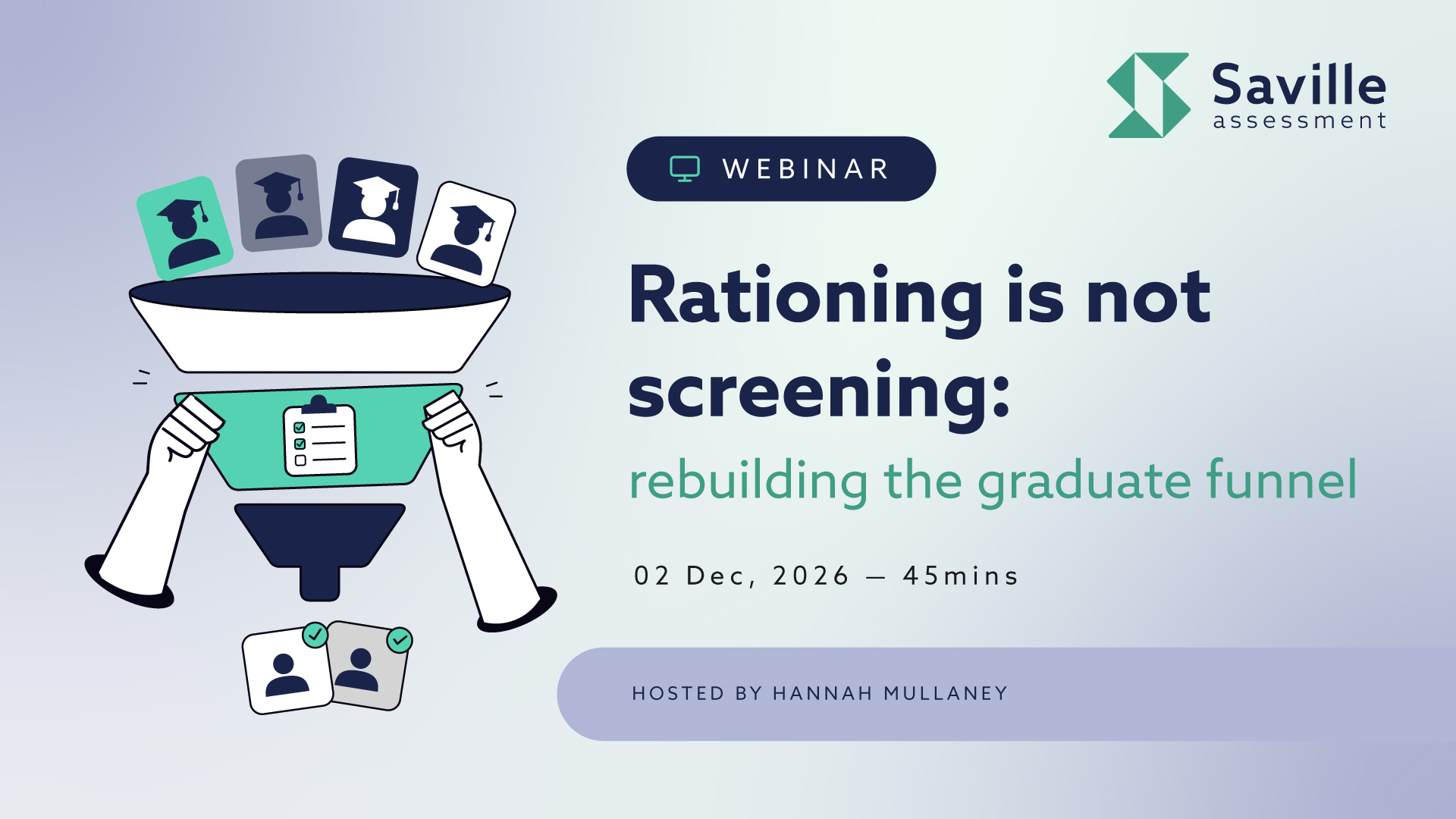
Live on Wednesday 2 December 2026, 3:00pm GMT. 45 minutes.
Graduate and early careers teams are receiving more applications than they can handle for every vacancy, and most of the tools added to cope with that volume were built to shrink the pile rather than read it better.
Plus a live rebuild of a graduate funnel at ISE (Institute of Student Employers) benchmark volumes, costed in recruiter days.
The question under every volume control
Across ISE’s 2026 sample, 68% of employers now screen applications with automated eligibility questions, 46% have shortened their apply windows and 41% cap how many roles one candidate can enter.
Every one of those reduces the number of applications. Whether any of them improved the shortlist is the question we put to the data, and to the room.
- Applications per graduate vacancy: 141
- Employers using automated eligibility screening: 68%
- Employers calling volume their biggest concern for the next five years: 60%
Source: ISE Student Recruitment Survey 2026, Institute of Student Employers
Where the early careers funnel leaks
Seven in ten early careers employers still bring candidates to a face to face assessment center, and nearly three quarters use an in-person stage before they decide. Those are the most expensive hours in the process, and they are filled by a screen that was never built to predict anything. We will put real numbers against what that costs, and what changes when the order of the funnel changes.
What you will take away
- How your application volumes, cost per hire and recruiter load compare with the 2026 ISE benchmarks
- What the ISE data says about whether the common volume controls are working
- What a measure has to do to be worth giving to every applicant
- A live rebuild of a graduate funnel, costed in recruiter days and interview hours
- How a two-minute screen changes the economics and the quality of results
Who this session is for
Heads of early careers, graduate recruitment leads and talent acquisition managers running high volume campaigns, in organizations hiring from a few dozen to several thousand early careers roles a year. If you ran a campaign this autumn and the application numbers beat your plan, this is built for you.
Register for the session
45 minutes, including 10 for your questions. The recording will hit your inbox whether or not you make it live.